Joseph’s predicament

The Text: Matthew 1:18-25

Today’s focus is going to be on Joseph and his part in the coming of our Lord8f5d0040f261ddb1b3f281e00e1385f0 Jesus. So let’s begin with a little Bible quiz about Joseph—just three quick questions…

  1. 1. Do you remember what Joseph’s trade was?

He was a carpenter. We think of Jesus as a carpenter, but that’s mainly because we know Joseph was a carpenter. In the Gospels according to Matthew and Mark, people ask of Jesus, ‘Isn’t this the carpenter’s son?’

  1. 2. Here in today’s Gospel Reading is the first time we hear of Joseph. Do you remember the last time we hear of him in the Gospels?

It’s in the Temple twelve years after Jesus’ birth, when Mary and Joseph lost Jesus because, as Jesus says, he was in his true Father’s house. We hear of Mary right up to the crucifixion, but the last we hear of Joseph is when Jesus is twelve years old, which leads most people to guess that Joseph probably died some time after that, perhaps because he was older than Mary. But we don’t know that for sure.

  1. Now for the last quiz question. Do you remember how many things Joseph says in the Gospels?

It’s a trick question actually. The answer is…none; not one recorded word from Joseph. Joseph comes across as the ‘strong, silent’ type and we’ll return to this later in the sermon. 

For these sorts of reasons, Joseph is an intriguing and even mysterious character. But what we want to see today is that his role in God’s plan of salvation is no less significant because of it.

So, as we think more about Joseph, let’s look first at his predicament; second, at his task; and third, at his response.

First, what is Joseph’s predicament? His quandary? His dilemma? In simple terms, Joseph’s predicament is that he is pledged to be married to Mary; Mary is pregnant and the one thing Joseph knows for sure is that he is not the father. So what to do? 

If we probe a little deeper we can discover there’s actually two possible ways of reading this situation, both of which could leave Joseph in a difficult spot. The one we most commonly hear, is that Joseph assumed that Mary had been unfaithful to him. Now this may have been difficult just on the personal level. But more than that, according to the law and social custom, it would’ve created big problems for Joseph to take Mary as his wife if it was known she had been unfaithful to him. So divorce seems to be the inevitable end. The problem, then, is that this sort of thing could be punished quite severely according to the law. So Joseph is in a predicament. He is a righteous man, and comes across as a kind and merciful man. So what is he to do?

Well, he arrives at a less than ideal solution but the best he can work out—arranging the divorce, but doing it quietly and so not creating more problems for Mary. Quite a predicament! This is the most common way to read this situation, and I think is the most likely. But there is another possibility that is worth considering, which is how many in the early church understood this story.

According to the alternative understanding of this story, Mary told Joseph about the visit to her by the angel and the news that she would conceive by the Holy Spirit, and that Joseph believed her. So he wasn’t suspicious of her, but he believed her. One of the things to remember here is that Joseph wasn’t a modern materialistic sceptic. He was a faithful, believing first century Jew who would’ve been much more open to God’s miraculous intervention than people today would be.

So if this understanding of the story is correct, then the predicament of Joseph is that he is overwhelmed by the magnitude of what is happening and what he is being called to do. He perhaps feels unworthy about caring for the holy child. So again, what to do?

Okay, divorcing Mary and running away from the situation may not be the best option. But it’s the sort of thing a lot of the prophets felt like doing when God called them into his service. So whether Joseph is suspicious of adultery, or he is overwhelmed by the presence of God’s holiness, he finds himself in a predicament.

Now let’s pause, because there’s a connection here with our lives today.  

As people of God today, as married people, as Christian families, we find ourselves in our fair share of predicaments, don’t we? And if we take our faith seriously, if we want to hear what God has to say to us and live according to his will, this doesn’t necessarily mean we have less difficult situations. In fact it can mean we have more of them.

Let me give you a very simple example, which perhaps some of you are facing right now. Let’s say Christmas lunch this year is scheduled for 12:30 at the rellies’ place. This part of the family isn’t involved in the life of the church. The problem for you is that it’s a two hour drive to their place. Church is at 9:30. So by the time we finish and get on the road you’re thinking: “Hmm, are we going to make it? Are they going to be upset if we’re late?” And so on…

Now at one level this may not sound like a big deal. But still, this small example can simply illustrate for us that our faith constantly raises these predicaments, dilemmas, and difficult situations. Many of you are facing your own particular ones right now, no doubt. In these experiences it can simply be good to remember that even the ‘holy family’ of Joseph, Mary and Jesus was not exempt. God’s interaction in their life is disruptive and confusing, at least at first.

Do you think it’s hard being late to lunch because of church? Imagine explaining that you’re late to lunch because an angel had just visited you! And in fact it gets a lot worse after this for the holy family, because they are forced to flee to Egypt to escape Herod. But notice too, that God does not leave Joseph in his predicament. God intervenes through his angel and reassures Joseph, comforts him, and assures him who this child is and where he is from. God’s enters into Joseph’s predicament.

Now we are not promised such extraordinary angelic interventions in all our difficult situations. But let us be open to God’s coming into them, to lead us through them, and to work all things for good according to his purposes.

So that is our first point: The predicament of Joseph.

Now we move onto the task of Joseph. What is Joseph actually called to do?

The reality is that biologically, Joseph was not needed. We confess from this text and from Luke’s account that we believe… ‘In Jesus Christ our Lord, who was conceived by the Holy Spirit…’ The Christian church has always confessed that the conception of Jesus was a miracle. The church confesses that the Son of God became a human being in this world not through the normal processes of a man and woman coming together, but through the power and work of the Holy Spirit in Mary. Biologically speaking, Jesus had no human father. So what is the task of Joseph?

You could say Joseph is called to be a foster-father of sorts—to adopt and care for and protect Jesus as his own. He certainly does a good job of that especially in the flight to Egypt. So Joseph is sometimes called the guardian of Jesus. Notice too that Joseph is addressed by the angel as ‘Son of David’.

So, there’s something going on here to do with the fulfilment of the covenant that God made with David—that by Joseph becoming Jesus’ legal father the rightful King will come to his throne. But connected to this in the text, we read of a very specific task Joseph is given, which is the naming of Jesus: ‘Do not be afraid to take Mary as your wife, for the child conceived in her is from the Holy Spirit. She will bear a son, and you are to name him… Jesus…’

Now, you’ve probably noticed that names seem to carry a lot more significance in the culture and time of the Bible than they do for us today in our culture. But even today we still often spend a lot of time thinking about what to name our children, don’t we? It’s fairly important to us. Just imagine if someone tried to restrict this freedom. Imagine if the government tried to tell people what they could and couldn’t name their children! We seem to instinctively know there’s something very important about names, and so there is a certain honour and gravity in the giving of a name.

So Joseph’s task is to name the child, not using a name of his own choosing, but with the name the Lord supplies: ‘You are to name him Jesus, for he will save his people from their sins.’

Let’s think a little about the name Joseph is to give the child. The name ‘Jesus’ comes from two Hebrew words, which together mean ‘the Lord saves’. Notice the emphasis in his name—Jesus comes to save. This is who he is; this is his work; this is his mission. He comes to save his people. He comes to save you.

Jesus does other things. He teaches, he heals, he works miracles, and so on. But everything else serves this main purpose of being the Saviour. This is no small point. Just about everyone is willing to acknowledge Jesus in some way—as a great teacher, as a spiritual guru, or as a nice guy. But the only way to truly know him is as the Saviour.

The reason that it’s difficult to acknowledge him as Saviour is that it also requires realising your problem is much deeper than you think. So, for example, if all we need is a bit more information and guidance, then Jesus the teacher will do. But if our problem is that actually we are broken from the core; if our condition is terminal, then we need a Saviour. And notice what he saves from!

Many people of that time were hoping for a saviour—a saviour from the Romans, a saviour from their enemies, a saviour from all the problems out there. But the angel says he comes to save his people from their sins. Salvation is about delivering us from the problem inside of us—in our sinful hearts.

Jesus comes to save you from your sins. He does this by taking your sins on himself on the cross, and so removing their power. And he’s not only Jesus, the Saviour. He’s also Immanuel; God with us, God for us. So that’s the awesome task of Joseph—naming Jesus.

Now finally and more briefly, let’s note the response of Joseph, which is the obedience of faith. ‘When Joseph awoke from sleep, he did as the angel of the Lord commanded him; he took her as his wife, but had no marital relations with her until she had borne a son; and he named him Jesus.’

One of the striking features of both Mary and Joseph in the Christmas event is that when the angel comes with the news of Jesus’ birth and gives instructions concerning it, to use the words of the old hymn, they simply ‘trust and obey’. With Joseph it stands out even more because of what we said earlier about there being no record of anything he said. All we have is his action. Joseph hears, trusts, and does what God has called him to do. At the beginning he was in a predicament and he was unsure and unclear about what to do. He had to work it out as best he could and choose a course of action.

But with a clear word from God to him, there’s no great deliberation, no argument, and no second guessing. He simply hears, trusts, and obeys.

So what about for us?

It’s true that there are situations we find ourselves in in which it is not always easy to know what God would have us do. Things can be unclear to us, and so we are called to use our Christian wisdom to find the best course of action we can. But perhaps there are not as many of these as we think there are, and in our lives there are often situations which we make more complicated because we have trouble simply obeying the clear and simple word of God.

There’s a time for deliberation and discernment. There’s even a place for wrestling with God, and asking our questions, and pouring out our hearts’ struggles to him. But there’s also a time for simple, trusting obedience. This obedience does not put us right with God. We stand right before God by faith in Jesus Christ. But from our faith flows a joyful obedience.

So as you face predicaments in your Christian life, remember Joseph, and, as Joseph did, trust God to intervene and lead you through them. As we celebrate the birth of Jesus, remember Joseph, the one charged with giving the child the name and all it means, Jesus, the Saviour from sin. And as you believe in Jesus, your Saviour, may a simple and joyful obedience to God’s will overflow in your life. Amen.

Jesus & John the Baptist

The Text: Matthew 11:1-12

 1After Jesus had finished instructing his twelve disciples, he went on from there to teach and preach in the towns of Galilee.8f5d0040f261ddb1b3f281e00e1385f0

2When John, who was in prison, heard about the deeds of the Messiah, he sent his disciples 3to ask him, “Are you the one who is to come, or should we expect someone else?”

4Jesus replied, “Go back and report to John what you hear and see: 5The blind receive sight, the lame walk, those who have leprosy are cleansed, the deaf hear, the dead are raised, and the good news is proclaimed to the poor. 6Blessed is anyone who does not stumble on account of me.”

7As John’s disciples were leaving, Jesus began to speak to the crowd about John: “What did you go out into the wilderness to see? A reed swayed by the wind? 8If not, what did you go out to see? A man dressed in fine clothes? No, those who wear fine clothes are in kings’ palaces. 9Then what did you go out to see? A prophet? Yes, I tell you, and more than a prophet. 10This is the one about whom it is written:

‘I will send my messenger ahead of you, who will prepare your way before you.’

11Truly I tell you, among those born of women there has not risen anyone greater than John the Baptist; yet whoever is least in the kingdom of heaven is greater than he.

In today’s text, Matthew tells us that John is in prison. He had been arrested by Herod because John had condemned Herod’s adulterous relationship with his brother Philip’s wife. John was simply being faithful to God’s Word. John the Baptist showed his love for God by not compromising his word, and he loved Herod too―really loved him by pointing out the hard truth to him and calling him to repentance, in accordance with God’s own definition of love in 1 Corinthians 13―that love rejoices in the truth.

Okay―people don’t like to hear the truth that hurts―but being imprisoned for speaking it? It wasn’t meant to turn out like this for John, was it? Maybe that’s the reason for John’s question of Jesus: “Are you the one to come, or should we wait for another?” The reason behind John’s question has resulted in quite a deal of debate and uncertainty among scholars for a long time. Was John doubting that Jesus was really the Christ? After all, John has faithfully prepared the way for him. Yet instead of the situation getting better it has only become worse. John had proclaimed that the Christ would come to bring judgment on evil―and now languishing in prison as a victim of injustice perhaps that is what John is longing for Jesus to do for him.

Or perhaps John was uncertain or confused because his proclamation was of a Messiah coming to bring judgment. He had heard in prison of the works Christ was doing―but where was the swinging of the axe that had gone below stump level and was already at the roots? The only works John had heard were those of forgiveness, healing, and mercy―would another follow Jesus, who would perform these works of judgment?

Or could it be that John’s question is not one of doubt, but really a question of trust―expecting confirmation and verification for what he already knows? The fact that John sends a delegation to Jesus with his question and awaits an answer from him proves his faith in Jesus. I’m not so sure it need be an either/or answer. Could it not be all of these thoughts are running through John’s mind while he waited and waited in prison?

It seems like we wait and wait too. Come Lord Jesus we pray. We don’t like waiting, especially in today’s society. But today’s text doesn’t just leave us with the questions. Jesus gives his own response. Notice that Jesus doesn’t say: “Yes, go and reassure John that I’m the Messiah.” But Jesus says: “Go and tell John what you have seen and heard: the blind receive their sight, the lame walk, lepers are cleansed, and the deaf hear, the dead are raised up, the poor have good news preached to them.” This is the best assurance possible, for what Jesus says is the direct fulfilment of what God promised through Isaiah in today’s Old Testament reading. Jesus is the fulfilment of what has been promised from of old. He has been doing precisely these things since the beginning of his public ministry. He has preached in the synagogues. He has cast out demons. He has healed many from their sicknesses including a lame man and a blind man. The miracles point to his authority and power over all things, even to release people from their sin and the kingdom of darkness, and to be victorious over the power of death itself. It’s no wonder Jesus tells them, “Go and tell John what you have seen and heard.”

Perhaps at some point or other we can all relate to John the Baptist as he waited in prison. Just like John, everything we might expect or hope for from God is not always fulfilled in the way we’d like, or with the timing we’d like. Maybe it’s an illness that we or a loved one suffer, or the troubles of our family. Maybe it’s a time of difficulty we’re going through, or maybe it’s wondering about an uncertain future. We might feel trapped and isolated with burdens nobody else could understand. We might feel imprisoned by our frail bodies or our own sinful human natures.

Yet the season of Advent focuses our attention on God who did not abandon his creation but stepped into it in the person of Christ and was born in that stable at Bethlehem. However if Advent were just a reminder of what had happened in salvation history then it becomes emptied of so much hope and power. Neither is Advent only about hoping Christ will come again one day. In The freedom of a Christian, Luther says

“…it is not enough…to preach about Christ just by telling what he did and said, simply as a story or as historical facts. Just knowing these things doesn’t necessarily make any difference to how a person lives.

Instead, Christ ought to be preached about in such a way that faith in him is kindled and kept burning, so that he is not only Christ, but Christ for you and me; so that what we are told he is and does takes effect in us. Such faith is produced and grows in us when we are told why Christ came, what he has brought and given us, and what good things we have when we have him.”

Together with our remembering and hoping, this is why the season of Advent is so special. Jesus came for us. He was born, truly human, for us. Born there in a stable surrounded by dirt and animals and their waste, Jesus came to us to know what it means to be a person and live in vulnerability and weakness and brokenness. He overcame temptation for us and lived perfectly for us. He came to rescue us and bring us true freedom by calling us into God’s Kingdom.

No one knows when he will come again but he tells us where he comes now with his re-creative power at work. He tells us where he comes in the midst the suffering of this world to bring the Good News to the blind, the lame, the sick, and the poor. Through the Holy Scriptures he continues to teach us, just like he taught his disciples in verse 1. He raised us from the dead and brought us his new life and resurrection power in baptism. He continues to bring freedom and release through the holy meal he serves his people which is not just bread and wine but his own flesh and blood. As he ministers to us through these ways, he calls us to wait―and to wait with him. As we do wait for his return we can rejoice that he will never leave us. As we wait with our Advent King and gather around him to be served by him, we proclaim to the world that he has trampled over death and lives today, and that he uses his authority to bless unworthy sinners with the abundant grace of God, so that there is hope and strength, joy and refuge in even the darkest places of human experience.

Blessed are those who do not take offence at Jesus’ words! For those who cherish Jesus’ words rather than taking offence at them can only do so because they have first been blessed by God. And those who have been blessed by God so that they do not take offence at the words of his Son—but hold firmly to them in faith—will see John the Baptist and all the other saints of all times and places, as we gather around the throne of the Lamb in heaven.

Amen.

Prepare the way for the Lord

Matthew 3:1-12


In those days John the Baptist came, preaching in the wilderness of Judea and8f5d0040f261ddb1b3f281e00e1385f0 saying, “Repent, for the kingdom of heaven has come near.” This is he who was spoken of through the prophet Isaiah:

“A voice of one calling in the wilderness,

‘Prepare the way for the Lord, make straight paths for him.’”

John’s clothes were made of camel’s hair, and he had a leather belt around his waist. His food was locusts and wild honey. People went out to him from Jerusalem and all Judea and the whole region of the Jordan. Confessing their sins, they were baptized by him in the Jordan River.

But when he saw many of the Pharisees and Sadducees coming to where he was baptizing, he said to them: “You brood of vipers! Who warned you to flee from the coming wrath? Produce fruit in keeping with repentance. And do not think you can say to yourselves, ‘We have Abraham as our father.’ I tell you that out of these stones God can raise up children for Abraham. The axe is already at the root of the trees, and every tree that does not produce good fruit will be cut down and thrown into the fire.

 “I baptize you with water. But after me comes one who is more powerful than I, whose sandals I am not worthy to carry. He will baptize you with the Holy Spirit and fire. His winnowing fork is in his hand, and he will clear his threshing floor, gathering his wheat into the barn and burning up the chaff with unquenchable fire.”

Repentance―it’s a key theme of advent and clearly a focus of today’s Gospel reading. “Repent.” That word is the opening word spoken in today’s text. It’s not even softened with a sugar-coated preface. Human ears don’t like that word. It’s a word frowned upon and laughed at by society. It’s an idea that society says oozes with irresponsibility because it gets in the way of personal freedom in deciding and claiming for ourselves what we think is our right to have. Society protests: “How dare anyone else try to snuff out my right to have whatever I want, whenever I want it and tell me what I should and shouldn’t be doing!”

Even in the church it’s a word that grates and cuts against the grain of our human nature. “Outdated!” “Not progressive!” “Unloving!” “An impediment to mission!” we might argue. Or, those of us who call the church to take a stand against immorality might be heartened when we hear the word ‘repent’―until we realise that word is spoken to the unacceptable things we think or say or do ourselves. Then we quickly get to work at building the self-justification fortress: “Repent!?! Me?! We’re not that bad!!” our old self protests. “OK, we’re not perfect, but we’re pretty good.”

John the Baptist didn’t come to tell people everything was ‘OK’. “Repent!” he calls. What an unusual sight he must have been, eating locusts and wearing garments made of camel’s hair, the food and attire of the very poor. As he stood there in the wilderness, the hot, uninhabited gorge through which the Jordan flows―itself symbolic of the spiritual wasteland of the people’s hearts, devoid of any love for God―John drew people into a place where they were without the luxury, comforts, and security of their normal daily routine, to reflect on what they had prioritised in their life and how their priorities were at odds with God’s.

John saves the strictest rebuke for the Pharisees and Sadducees, very different religious sects in Israel, but with a common problem―they are assuming that because they were born into the covenant people Israel, they will be saved from the wrath to come simply because of their ancestry. Yet their hearts are far from God. They had all the external marks of religious respectability―and that is what they are trusting in. They have the false confidence that they have Abraham as their father and so have an automatic right to heaven. But they did not bring forth the fruit of genuine repentance and humility before God. John calls them to repent. He warns them the axe has gone far below the stump of the trees; it is already at the roots. Not so much as a twig will remain―God’s judgment is that they will be completely removed from the privileges he has given them.

Why does John make this call to repentance? Because the Kingdom of Heaven is near. Through the ages there have been so many predictions about how near the Kingdom of Heaven really is―even though Jesus teaches us that no-one knows the day or hour. “Repent, for the Kingdom of Heaven is near”―those words can be hard for us to hear for other reasons―just how near is God’s Kingdom, given that these words were spoken some 2,000 years ago? How then can we be firm in hope that God’s Kingdom is near? Is it an empty promise?

Although we don’t know when God’s Kingdom will come again, we can know where it comes now. A kingdom is where ever its King rules over his subjects. In his explanation to the petition “Thy Kingdom come”, Luther explains in the Small Catechism: “God’s Kingdom comes indeed without our praying for it, but we ask in this prayer that it may come also to us. God’s Kingdom comes when our Heavenly Father gives us his Holy Spirit, so that by his grace we believe his holy word and live a godly life on earth now, and in heaven forever.”

With this understanding of the kingdom, it might be easier to see what the Baptist means when he says: “Repent, for the kingdom of heaven is near.” The Kingdom is near―close by―in Christ, the King of heaven, who came all the way from heaven down to earth, born in a stable at Bethlehem to be God with us. In him the kingdom has drawn close by to us, and indeed is in us, as Christ rules over our hearts and uses his authority and power to serve sinners and bless them with his grace and bring, love, forgiveness and joy. John was the one that Isaiah had spoken of in Isaiah 40:3-4:

A voice of one calling in the wilderness:

“Prepare the way for the LORD;
make straight in the desert a highway for our God.

Every valley shall be raised up, every mountain and hill made low; the rough ground shall become level, the rugged places a plain.

Isaiah says that mountains and hills are to be levelled and valleys raised up. The hills and valleys are symbolic of the sin in the human heart that separates people from God. Just as levelling mountains and raising valleys is a task beyond human ability, so too is making a way through sin to fellowship with God. It is a task that is utterly beyond human power. Only God is able to construct a way through such obstacles. He must prepare a highway to come to his people and deliver them. That is what Jesus does for us. Notice that our reading does not say: “Make a straight path so we can travel to him.” It says “Make a straight path for him to travel”. God has made the roadway and travelled it first in the person of Christ. He has come near to us.

He made the way straight for you in your baptism, where the rough ways and mountains and valleys in your heart were transformed by the power of the Holy Spirit at work through God’s word. Christ came to you and washed you clean at the font and joined you to his own death and resurrection. You were born again from above and the Holy Spirit created faith in your heart, calling you to Christ through the Gospel—even if you were asleep and blissfully unaware of what was taking place, and even if you cried and squirmed and protested.

Since the Kingdom is so near in Christ who reaches out with God’s grace, it is only appropriate that all people should long to receive this Kingdom and turn to Christ with their sins for him to free them from them. John the Baptist’s call to repentance is for our ears too. It is not just to escape judgment but to receive grace. For us the call to repentance is because, though Christ will come again, he is also already here. The freeway has been opened! In the person of Christ, the Kingdom of heaven is near, again, today. He has already spoken his absolution to you this morning. He has come with good news for you through the words of Scripture. He serves you this gospel as a holy meal that he hosts―his true body and precious blood. As he hands it to you he says: “This is my body given for you. This is my blood shed for you for the forgiveness of sins.”

The Kingdom of Heaven is near. It is 2000 years closer than when John first spoke these words in the Judean wilderness. The Kingdom of Heaven is near to you as we, the church, live in the wilderness of this age―the wilderness of western materialism, spiritual supermarkets, and spiritual wasteland of living for the self. The Kingdom of Heaven is near to you as we live in a consumer age that looks to filling the valleys of loneliness and the potholes of anxiety with things that promise hope but can’t give lasting peace. The Kingdom of Heaven is near to you as you live in a society with all its ethical and moral upheaval that has so many different ideas about what walking the straight path looks like, depending on opinion and trends. The Kingdom of Heaven is near to you as the church lives in a world that doesn’t want to hear the call of John the Baptist and in some parts would do anything to drown it out.

In days like this many of us might groan and wonder “Lord, how long? How near is your return?”

Rejoice that the Kingdom of Heaven is near to you, because you have the Christ. When we hear John’s words: “Repent for the Kingdom of heaven is near” we don’t know when that is…but we do know where. Thinking of the Kingdom of Heaven being found close by is actually of far more help to you than speculative dates of Jesus’ return. For when you look for the Kingdom of Heaven close by in worship; in God’s word and sacraments and in devotional time in the word of God each day, there Christ meets you with all the treasures of his grace, forgiveness, life and salvation for you. Looking for him there with repentant hearts and open hands waiting to receive is the best way to prepare for Christmas and your Saviour’s coming again―when he will take you to be with all the other saints of all times and places and serve you in the heavenly banquet that has no end.

Amen.

Clothed in Christ

Romans 13:11-14  8f5d0040f261ddb1b3f281e00e1385f0

‘Rather, clothe yourselves with the Lord Jesus Christ…’(v14a NIV)

A lot of people say that you should never judge a book by its cover. There’s probably a lot of truth in that when we apply it to people; because there is usually a lot more going on in people’s lives than what we can see when we look at them. However, there are times when you can tell a lot about who people are and what they do by the way they dress.

For example, you can probably tell if people are firefighters by the uniform they wear, and that their job it to put out fires. People dressed in surgical scrubs are probably surgeons who operate on patients to help them recover from illnesses or injuries. Someone in a sporting uniform will most probably be an athlete who competes in a particular sport. Depending on the sport, the clothes that athletes wear might even tell us the position they play or what their role is in the team.

In each of these cases, there will be consistency between what a person wears, who they are and what they do. You wouldn’t want a person dressed like a fireman to do surgery in the operating theatre. Cricketers dressed like surgeons won’t be able to compete to their full ability. And there is no way you would want to fight a fire dressed like a netballer or a swimmer. What we wear can say a lot about who we are and what we do.

When the Apostle Paul encourages the Christians in Rome to be dressed in Christ, he wasn’t giving them fashion advice. Paul was encouraging the readers of his letter to find a new sense of who we are and what the purpose of our lives are through faith in Jesus.

Through his life, death and resurrection, Jesus covers our sin, shame and guilt and gives us a new identity as children of God. Through faith in Jesus, the Holy Spirit washes us clean of everything that makes us unacceptable to God, to others and even to ourselves, and covers us with the goodness, righteousness and purity of Jesus. When God looks at us, he doesn’t see our flaws, mistakes or failures. Instead, because we are clothed in Christ, God sees us as his children whom he loves and with whom he is pleased (see Matthew 3:17; Mark 1:11; Luke 3:22).

In the same way that the clothes firefighters, surgeons or sportspeople wear can tell us who they are, so being clothed in Christ tells us that we are God’s children who receive all of Jesus’ goodness as his gift to us through the Holy Spirit.

Just as it makes sense that what a firefighter, surgeon or sportsperson does will also reflect who they are, so the way in which God’s children live their lives needs to be consistent with being dressed with Jesus and who we are in him.

As surely as it is absurd to think of a fireman in an operating theatre, or a surgeon on a netball court, or a footballer fighting a fire, it makes just as little sense for the children of God to live in ways that are different from who we are as people who are clothed in Christ’s goodness. That is why Paul writes,

‘So let us put aside the deeds of darkness and put on the armour of light. Let us behave decently, as in the daytime, not in carousing and drunkenness, not in sexual immorality and debauchery, not in dissension and jealousy.’ (v12b,13 NIV).

Paul is urging us to be clothed in the goodness of Jesus so we live good lives which show the world who we are as God’s children.

When we live faithfully as God’s children, we bring the light of God’s goodness into a world that is often very dark. As we begin the season of Advent, in the coming weeks we will be remembering God’s gifts to us of peace, hope, joy and love.

People who live in our world, who live right next door to us, or maybe even live under our own roof, often need a greater sense of peace, hope, joy and love in their lives.

As we live in ways that are consistent with our new identity as people who are clothed in Christ, we can be the means by which God brings his peace, hope, joy love and light into people’s lives.

Christianity isn’t about following a set of rules to get into heaven, like a lot of people imagine. Instead, the Christian faith is about finding a new sense of who we are as people who are covered by Christ, and then living in ways that reflect our new identity as God’s children so God’s goodness and love can come into the world through us.

We all put our clothes on every day. This week, as you get dressed, remember that God gives you the goodness and love of Jesus to put on each and every day.

Jesus covers each of us and gives us a new identity as children of God whom he loves and with whom he is pleased, even before we do anything. In this garment of faith we are clothed with Jesus; all of his goodness and purity. And so we live each day as God’s children and bring the light of his peace, hope, joy and love into the lives of everyone we meet through all we say and do.

May the peace of God which passes all understanding keep our hearts and minds in Christ Jesus. Amen.

The crucified King

Text: Colossians 1:15, 20 

8f5d0040f261ddb1b3f281e00e1385f0Christ is the visible likeness of the invisible God. He is the first-born Son, superior to all created things…. Through the Son, then, God decided to bring the whole universe back to himself. God made peace through his Son’s blood on the cross and so brought back to himself all things, both on earth and in heaven.

Things are not always what they seem.  What seems to be the most obvious can be awfully wrong. The gospel reading today is another one of those cases where things are not what they seem to be. 

We heard the account of Jesus’ crucifixion as recorded in Luke’s gospel.  We are told how Jesus was nailed to a cross between two criminals. 
He is weak from all the beatings; his clothes are stripped from him and soldiers gamble for his robe; he suffers the mockery of those standing around the cross.  They call out, “If you are a king, then save yourself”.  They laughed at his weakness and inability to save himself, they joked about his claim to be a king and now his unkingly naked body was nailed to an instrument of torture – what a joke and what a good laugh they had – a king on a cross – what a ridiculous idea!

But there was one person who saw something in Jesus that no one else saw.  In spite of the gashes in his flesh from the whip, the nails, the wounds, the blood, the nakedness and the shame, one of the criminals crucified with Jesus recognised a king.  He said to Jesus, Remember me, Jesus, when you come as King!”  Jesus promised him, “Today you will be in Paradise with me”.

A strange king indeed – suffering, weak, humiliated, despised, rejected and dying.  But the death of this unlikely king made us friends with God through his death.  God was going to stop at nothing to break down all barriers between him and all people.  He was even prepared to let the King of king and Lord of lords die in order to make everything right again between him and us.

This is where Paul’s letter to the Colossians picks up the theme of the kingship of Jesus.  The apostle goes to great lengths to emphasise that Jesus is God’s Son; he is everything that God is.  Through him “everything in heaven and on earth, the seen and the unseen things, including spiritual powers, lords, rulers, and authorities” were created.  If he is the creator of all these then, he is also lord and king of everything in heaven and on earth.  Paul goes on to say that Jesus is not only king of every part of creation, he is also head of the church; “he is the source of the body’s life”.  

Things are not what they seem.  This king is all powerful, above all things, the lord of all and master of the whole universe, with multitudes of angels at his beck and call, living in the perfection of heaven.  Yet it was not above this king to get down and get dirty.  Jesus doesn’t just dress up to be like us, he is one of us.  He takes on our human nature and lived among ordinary people especially sinners and outcasts, including lepers and the demon possessed.  What happened to him could hardly be regarded as being kingly. 

He died on a cross.  Just grasp the magnitude of this.  The King of kings and Lord of lords, God’s Son, died on a horrible human instrument of torture and death.  Not only that, he died for all those who are enemies of God because of the evil things they did and thought (Col 1:21).

In his usual clear and precise way, Paul says, “By means of the physical death of his Son, God has made you his friends, in order to bring you, holy, pure, and faultless, into his presence” (1:22).  That’s worth repeating to make it sink in.  “By means of the physical death of his Son, God has made you his friends, in order to bring you, holy, pure, and faultless, into his presence”.

Today is the last Sunday of the church year and it is traditional to talk about the end of the world, the end of our life here on this planet as we know it and the certain judgement of God on the Last Day. 

This image of the servant-king that Paul and Luke paint for us is so important as we face the prospect of coming face to face with the holy and righteous God.  There’s no denying that we are sinners. 
There’s no getting around the fact that right up to the last day of our life we will continue to sin in thought, word and deed.  The Bible makes it quite clear that our sin condemns us and we would have no chance of surviving the judgement of God on the last day. 

But Paul makes it clear that there is nothing to be afraid of.  Christ has died for us.  Jesus is master and king over sin, death and the power of Satan to condemn us.  Jesus’ death has made us friends with God again and made us holy, pure and faultless.  Our sin has been wiped away.  Forgiven.  Forgotten.  We will be welcomed into heaven.

Isn’t that what happened to the man dying next to Jesus.  In his moment of deepest agony, Jesus tells the criminal who sees in Jesus a king that his sin will no longer be held against him.  “Today you will be with me in Paradise”.  At a moment when all would seem to be hopeless and without a future, Jesus is truly a king.  He pardons and assures the man that he will be with him in Paradise. 

Without a doubt, there is a future after death and after the end of this world.  Jesus promised the man next to him, “Today you will be with me in Paradise”. 

We have a servant-king who died for us and rose from the dead, who has done everything possible to ensure that we need not fear what will happen.  At the end of everything, we are safe.

Kings and crosses don’t normally go together but in the case of Jesus they do.  Jesus may have been raised to the highest place and given the name that is greater than any other name (Phil 2:9) but this mighty king cannot be separated from the cross on which he died saving you and me.  As Paul so nicely summarised, His Son became a human and died. So God made peace with you, and now he lets you stand in his presence as people who are holy and faultless and innocent” (Col 1:22).

Worship this different kind of king, this Jesus, and trust him.
This is our king – nailed to a cross to rescue us from the powers of darkness and sin.

This is our king – risen and ruling, and “openly proclaim that Jesus Christ is Lord, to the glory of God the Father” (Phil 2:11).

God’s uninterruptible love

Text: Luke 21:10-12, 18, 19

church4“Countries will fight each other; kingdoms will attack one another. There will be terrible earthquakes, famines, and plagues everywhere; there will be strange and terrifying things coming from the sky. Before all these things take place, however, you will be arrested and persecuted; you will be handed over to be tried in synagogues and be put in prison; you will be brought before kings and rulers for my sake. …. But not a single hair from your heads will be lost. Stand firm, and you will save yourselves.
Interruptions can be annoying.  You decide that it’s time to start your Christmas cards and letters but as soon as you put pen to paper someone in the family is hungry, can’t find something, or your phone rings there goes your good intentions. 

Sometimes interruptions, though initially annoying, can be creative and constructive.  The whole story of the Bible can be looked at from the viewpoint of interruptions.

The devastating effects of sin interrupt the peace and harmony of life in the Garden of Eden.  Sin interrupts God’s plans for the world.  God had created a beautiful world and had put beautiful people in it but sin interrupted the beauty of God’s world.  In turn God interrupts sin by becoming a human being who lives among us filled with grace and truth and dies for us.

Moses was happily looking after sheep and keeping out of trouble when his life was interrupted by a voice from a burning bush.  It was God who was challenging him to step out of his comfort zone and demand that the king of Egypt let the people of Israel go free.

God’s people were caught in sin and were drifting away from God and so he interrupted the lives of ordinary people and sent them as prophets to interrupt their drift away from him and bring them back into a relationship with their Creator and Saviour.

The announcement of the birth of Jesus interrupts a young girl’s life and her wedding plans.  The silence of the night is interrupted when angels announce the birth of the Messiah.

A traitor friend who needs to go and sell his Lord for the price of a slave interrupts Jesus’ celebration of the Passover with his disciples.  This same traitor and the armed guards interrupt Jesus’ prayers in the Garden.  And finally, the sadness and confusion after Jesus’ death is interrupted by the news that he has risen.  His tomb is empty.

Interruptions are events in our lives that can’t be forced back any more than we can hold back the tide.

Today’s difficult gospel text makes us aware of the interruption that will affect the whole world.  Jesus is leaving the temple and he is looking around at one of the most magnificent structures in the world at that time.  He tells his disciples that this grand monument will be destroyed.  We know that this happened at the hands of the Romans.  The history of the temple will be interrupted and brought to an end, he says, and it was. 

He goes on and says that everything we cherish, every institution and tradition, every treasure that we count on and store up will be interrupted and brought to an end.  Wars, earthquakes, famines, and other disasters in nature, persecutions when family members will rise up against other members of a family, will interrupt our way of life and the peace we enjoy. 

Peace and safety in our world and in our community are very fragile things and can easily be interrupted by hostility, bloodshed, robbery and fear. The interruptions that we experience almost on a daily basis are reminders that things in this world are very uncertain.                                                    

When you think about it, the interruptions that we experience in life can make us feel very insecure and uncertain.  Everything that we once considered solid and secure; what we once thought to be the centre of our happiness and peace can suddenly be interrupted and we are left with nothing.  Take the story of Job in the Old Testament who had everything and in an instant it was all gone.

But Jesus wants to make it quite clear in our reading today that there is one thing that will never be interrupted, that is, the love that our Father in heaven has for us.  Jesus says, “Not a single hair from your heads will be lost”.  Regardless of what may happen to interrupt our peace and happiness in this life, nothing will interrupt God’s love for us.

 “Stand firm”, Jesus says in the last verse in our reading.  Trust and believe in that love for you.

“Stand firm” and believe that Jesus’ love has forgiven all your sin and prepared a way for you to eternal life.

“Stand firm” and believe that he will stand beside you and help you no matter what kind of interruption will disrupt your happiness and peace in this life.
                                                                                                                                                                    “Stand firm” in the knowledge that even though all kinds of disasters may come  God loves you and he will not allow anything interrupt that love and care for you.

On the day we die or when Christ bursts into this world on the last day (whichever comes first), that will be the last interruption that we will ever experience.  There will no more interruptions by sickness, death, wars, natural disasters, accidents, crime or whatever.  We will be taken into God’s presence and join those gathered around the throne of God. 

In the meantime we need to deal with the interruptions that take place in our everyday life. How easily is our trust in Jesus interrupted?
How readily do we allow our pet sins interrupt the newness that we have in Christ?
How often do we allow or even try to find interruptions that keep us away from reading God’s Word, praying and worshipping together with our fellow believers?
How willingly do we allow our sinful nature and Satan interrupt our walking God’s ways?

God grant that the Holy Spirit would interrupt every sin, every temptation, every fear and doubt, and remind us every day that God’s love for us is uninterruptible.  God grant that our commitment and faith be as uninterruptible as God’s commitment to us.

The peace of God, which passes all understanding, keep our hearts and minds safe in Christ Jesus.

Amen.

All Saints Day.

Dear saints in Christ, I want you to have a quick look around, and tell me if anyone here is wearing a golden halo. Is there anyone here who is looking8f5d0040f261ddb1b3f281e00e1385f0 particularly saintly today? Your husband or wife or your Child perhaps? The fact is, we know that we’re all pretty human, and being human means “warts and all”. Most of us have probably said, “I’m no saint”. However, in just a little while we are all going to say the words, ‘I believe in the communion of saints’. And with these words we will confess our belief that there is more to the church than meets the eye.

 There is more to this Lutheran congregation, than meets the eye. The church is far more than a gathering of individuals loitering with religious intent. The church is, in fact, a communion of all people who have been made holy by Jesus – all believers in Christ, in all places, of all times. The communion of saints includes all Christians living now, all the faithful who have died, and even those believers who are yet to be! All of these are “saints” because they are baptized into Jesus, and all of these saints are a “communion”, because being united to Jesus makes us united to each other.

The thing I’d like to focus on today is that all Christians as saints. All baptised believers are holy, and that’s what the word ‘saint’ means: a holy person. And to look at the role that the saints (both living and departed) play in our lives, I’d like to focus on a passage from the Lutheran Confessions, one that I think all Christians could say ‘Amen’ to. Let me read the relevant passage to you.

Our Confession approves giving honour to the saints. This honour is threefold. The first is thanksgiving: we should thank God for showing examples of his mercy, revealing his will to save people, and giving teachers and other gifts to the church….The second honour is strengthening of our faith: when we see Peter forgiven after his denial, we are encouraged to believe that grace does indeed abound more than sin. The third honour is imitation, first of their faith and then of their other virtues, which each should imitate in accordance with his calling. (Apology, XXI)

Let’s look at these three ways of honouring the saints

  1. We give thanks to God for all his people. Because apart from the gospel and the sacraments, the saints are the greatest blessing the church has. Every saved man, woman and child is a wonderful cause for rejoicing. Every believer sitting in the pew today is evidence that God is still at work in the 21st century just as much as he was in the first. Every believer sitting here today demonstrates that miracles still occur. We should never stop giving thanks for the fact that despite all the faults we can find with others, and all the warts others can find with us, God has begun his work of salvation, and is daily working to bring it to completion.

Moreover, we can thank the Lord for those who taught us the faith and brought us to Jesus: our parents, our pastors, our teachers. Thank the Lord for every mature Christian who showed us what following Christ means. We thank the Lord also for ordinary Christians who have simply and steadfastly kept the faith, and for unknown Christians who were never remembered in this life, but will receive ample reward in the next. And, we can even thank the Lord for those living saints with whom we disagree, with whom we experience conflict, because they too are our brothers and sisters, and our unity in Christ transcends our disagreements and tensions. Every saint, in fact, is a demonstration of how much God wants to save us, how much he wants to forgive us.

  1. And that brings me to the second reason for honouring the saints: for strengthening our faith. Again and again we discover that the saints are forgiven sinners. They may have been heroes of the faith, but they were highly forgiven heroes! The greatest hymn-writer of the Bible, King David, was an adulterer and a murderer. Jacob, who was named Israel, was dishonest and tricked his brother Esau. Peter denied his Lord three times. Paul confessed to a lifetime struggle with sin. And yet, God’s grace triumphed over all their faults and his forgiveness covered their most disastrous sins. When they were weak, God showed his strength in them. Whenever they thought they had failed, God’s word returned to them having achieved all it set out to do. And how does this strengthen our faith? Well, if God has shown such mercy to them, think of what mercy he will show to us. If God has used other sinners, he will also use us. There is hope for us all!
  2. Imitate the saints who stand out are worth copying. They are good role models for the rest of us. St Paul quite unashamedly said: ‘Join with others in following my example, brothers, and take note of those who live according to the pattern we gave you’ (Philippians 3:17). We need heroes to inspire us. We have sporting heroes – why not faith heroes? A young Catholic I spoke to some time ago said that at their confirmation they chose a saint to whom they could look as a model and inspiration. What a good idea!

So, our honour of the saints is three-fold, say the confessions. We give thanks for them, our faith is strengthened by them, and we imitate them. To finish off, let me return to a point I made at the beginning:

  • The communion of saints is a spiritual reality, and therefore it’s something we can hardly begin to understand in this life. But because we are all joined sacramentally to Christ – through baptism and holy communion – we are also joined to each other. We share all things in common. The spiritual strength of some saints help and sustain those who are weak. On the other hand, the sins and weakness of others are shared by the rest as well. As Paul writes to the Corinthians: ‘If one part (of the body of Christ) suffers, every part suffers with it; if one part is honoured, every part rejoices with it’. So, on this festival of All Saints, let us give thanks for what we all share in common, and let us confess: “I believe in the Holy Spirit, the holy catholic church, the communion of saints”. Amen.

And may the peace of God, which passes all understanding, guard our hearts and minds in Christ Jesus. Amen.

A picture of our faith

There is a saying that states that “one picture is worth a thousand words”. HowScreenshot 2022-10-28 194115 true that is on so many occasions. I first heard about the Bali explosions on the radio. The news reporter attempted to give a verbal description of what had happened and the devastation that had occurred in that otherwise peaceful and fun-loving place. However, it wasn’t until I turned on the TV and saw the pictures of the destruction, the stretchers and ambulances, the overcrowded hospital that the full extent of the situation really hit home. Those pictures described what thousands of words weren’t able to do.

A couple of years when another driver attempted to remodel the look of my car by driving into while making a u-turn, I filled out a form for the insurance company. Included in this form was a space to explain what happened in words and another space to draw a diagram of what happened in the accident. The insurance company realised that often it is easier to draw a picture of what happened.

Companies and churches have logos and if they are good logos they tell you something in picture form about that organisation. The Lutheran Church of Australia has a logo. On it you will see a large gold cross, the Southern Cross and flames of fire – that tells you something about the LCA – the centrality of the cross of Christ, the Spirit at work through the church and the location of the LCA.

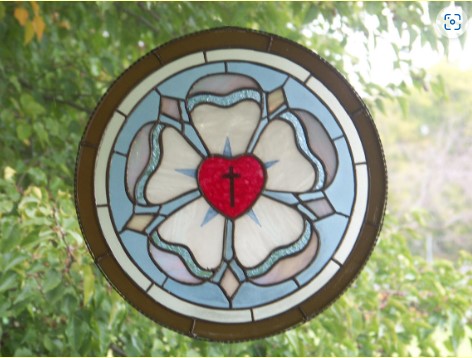
There is another symbol that is found in Lutheran Churches throughout the world. You will find this symbol on the front of church buildings and halls, you will find it included in the designs of the magnificent stain glass windows of Lutheran churches all over the place (including St Luke’s). You will find it in books and printed materials that are distinctly Lutheran in origin. I am talking about Luther’s Rose. Luther devised this logo as a summary of his faith. But not only of his faith but also that of all Christians. And so this logo is displayed in our churches as a picture of the Christian faith. You might say it is a sermon in picture form. Since today’s service is dedicated to commemorating the Reformation, it’s worth looking at it because it is a picture that will take a thousand words to describe this summary of our faith. Let’s start.

At the centre of Luther’s logo is a cross. The cross of Jesus is at the every centre of the Christian faith. Without the cross, there is no Christianity.

This cross is black in colour. Black is the colour of sin and evil – the darkness in our hearts and in the world that causes so much grief and pain. John’s Gospel says, “People love the darkness rather than the light, because their deeds are evil” (John 3:19). Black reminds us of our sinfulness. “Everyone has sinned and is far away from God’s saving presence” (Rom 3:23), the apostle Paul reminds us. Black is the colour of death – sin leads to death.

When Luther was a young man he was nearly killed and the thought of dying terrified him. He was not ready to meet God the eternal Judge. And so he left all of his friends, his well paid job, his family, and wealth in his search of a way to get rid of his sin and be right with God. He entered a monastery and prayed, and fasted, and studied, constantly. But still his heart did not feel at peace with God. He always felt too sinful to ever be called into the presence of God if he were to suddenly die. He never felt confident that he would go to heaven. So he prayed, and studied, and fasted more.

But the more he studied, the more he prayed, the more questions he had and the more doubts he had about how worthy he was before God. His sin and God’s judgement terrified him.

It was fortunate for Luther that he was studying the Letter to the Romans and gained a fresh insight into 1:17: The righteous shall live by faith. He realised that a person cannot be made right with God by trying to impress God. Salvation is a gift of faith from God – faith that believes and trusts in what Jesus has done for him. Salvation is freely available to all.

This was the answer to Luther’s searching and praying. He was elated. You cannot be saved without Jesus Christ. You cannot by pass the cross. Our sin is so great that it permeates and infiltrates every part of us, including every thing we say, do and think. It is impossible for us to step aside from our sinfulness for just one moment, and save ourselves, or dedicate ourselves to God, or give ourselves to God. Without God’s intervention, we would have no hope.

And so at the centre of Luther’s Symbol is the cross. The cross is the symbol of God’s acceptance, his forgiveness, his grace. Yes, we are sinners, but by the free gift of God’s grace all are put right with him through Christ Jesus, who sets us free (Rom 3:23). Through faith in Jesus, our sins are forgiven, we are accepted by God, we are welcomed by our loving heavenly Father.

In Luther’s logo the cross is placed on a red heart. Even though the cross is black, a symbol of sin and death and the shame that the Son of God had to die in such a terrible way because of our sin, the heart is red because it is a living heart. The gospel of forgiveness gives life. We have been saved, given life as children of his family, recreated, reborn, given a new heart to live as God wants us to live.

The heart is a symbol of love. Not only the love that God showed in sending his Son, but for the love that flows through us. We have been renewed to love God with all our heart, soul, and mind, and to love our neighbour as we love ourselves. The red heart indicates that since we are God’s children through Jesus death on the cross, this has an effect on the way we live our lives. As God’s people, we should turn away from everything that is evil and sinful and let God’s love be evident in everything we say and do. Paul says, “You are the people of God…. So then, you must clothe yourselves with compassion, kindness, humility, gentleness, and patience.  Be tolerant with one another and forgive one another …just as the Lord has forgiven you.  And to all these qualities add love, which binds all things together in perfect unity (Colossians 3:12-14).

A heart filled with God’s love is a busy, active heart. There is no room for complacency or laziness. Nobody receives the grace of God for private enjoyment. Nobody receives the gifts of God for private enjoyment. They are meant to be used to serve others.

The red heart is resting on a white rose. The white rose has been connected with the coming of the Messiah. The Christmas carol: Behold, a Rose is growing of loveliest form and grace, etc. The rose is the flower that indicates joy in the midst of the thorns of life.

And so the red heart and living the Christian life rests on the white rose. It is not easy being a Christian, a follower of Jesus in this day and age.
It is easy to be sidetracked,
it is easy to follow the crowd,
it is easy to forget that we have been called by God to be in his family and to do his work. We fail often, we confess that we have not done what God has called us to do. That is part of the thorny world in which we live.

But we experience the joy of the Good News of the Gospel, the joy of being renewed for service, and refreshed with sins forgiven and sent out again to do his work. For Luther, the rose was a symbol of this joy among the thorns of our world.

Because of the joy of knowing Jesus, our service to others is filled with joy. If we served our Lord grudgingly, it would not be service. If we went unwillingly, or with a grumbling spirit, our service would not be worth anything. True service, true worship, true discipleship reflects the joy that we have because of Christ.
What a joy to have a Saviour who loves us!
What a joy to know that our sins are forgiven!
What a joy to know that Jesus gives eternal life!
What a joy it is to be called as Jesus’ disciples in this world to pass on that love and hope of eternal life!

Everything about Jesus fills our hearts with joy. As Paul said: Rejoice in the Lord always. I will say it again: Rejoice!

The white rose rests on a sky blue background. The sky-blue background of Luther’s logo reminds us of the promise of eternal life that we have through Jesus Christ. Because Jesus rose from the grave, we too shall share in the bliss of heavenly joy and we look forward to that day when we will be in heaven with our Lord and with all those faithful people who have gone before us. It may happen that our life takes a turn for the worst – persecution for our faith, tragedy, ill health, crippling old age, the loss of our ability to think clearly – but there is one thing that doesn’t change or decay. We look forward to entering heaven when this life is over.

The sky-blue background reminds us that our life on this earth is for only a short time. We are here and then we pass away – not into nothingness or oblivion – but into the joy of eternal life.

Around the whole logo is a gold ring. Like a ring that has no end, the joy of heaven has no end, it will go on into eternity. The ring is gold, one of the most precious metals, and so indicating that the promise of eternal life is the most precious of all. In fact, you might say, everything relating to our faith is precious like gold and we value it more highly than anything else in all the world.

So there you have Luther’s Rose; a pictorial summary of the Christian faith. It is a symbol of a faith that is just as true and relevant today as it was in Luther’s time.

The logo not only gives us an understanding of our faith but challenges us to ask:
How central is the Jesus in your life or is he somewhere around the edges?
How readily have you accepted that Jesus has cleansed you from all your sin or do hang on to your guilt?
How ready are you to give up your pet sins and obediently live as someone who belongs to God?
How willing are you serve Christ through humbly serving others?
How well are you sharing the joy of the gospel with others?
How strong is your relationship with your Saviour – or is it a somewhat casual affair?
How confident are you that when you die, you will go to heaven? Or is there some lingering doubt that you won’t be good enough?
In what ways are you letting the love of Christ effect every relationship?

Look at Luther’s logo again and see that Jesus, God’s love, a renewed heart and Christian service are central to everything that we do personally and as a church.

Confess it, believe it and live it!!

© Pastor Vince Gerhardy

The purpose of life.

Jeremiah 14:7-10,19-22  2 Timothy 4:6-8,16-18  St.Luke 18:9-14

The Pharisees were dedicated to the preservation of Jewish culture in terms ofgordon5 the Mosaic law and its traditions relating to life and worship. They were jealous for the sacred history of God’s people; God’s unique provisions for the Jewish people. Israel as God’s people, made to be who they are as distinct from the rest of humanity by God’s gracious call of their ancestors, Abraham, Isaac and Jacob who is renamed Israel. This call took the form of a covenant- including the gift of the Law, the ten commandments. The unique identifier of the Jewish people and religion through their entire history to the present day. The Pharisees were the guardians of this tradition and the understanding of its significance for the survival of Israel as the people of God. Their description as Pharisees comes from the Hebrew word פרושים   prushim from  פרוש parush, meaning “separated,” that is, one who is separated for a life of dedication to law and purity.

When this story was told by Jesus, we very often overlook the fact that the original hearers far from being offended by the self-conscious righteousness of the Pharisee would find it wrong indeed, obnoxious, that a Pharisee should be unfavourably compared to a Publican. The publicans were the “tax collectors” for the Romans in the state of Israel. The word came from the Roman word “publicani.” Because the publicans were representatives of the pagan Roman conqueror, their work was detested. A Jew who chose to become a “publican” was viewed as a betrayer and a servant of the occupying power of Rome. He was about as far opposite to a Pharisee as one could be.

The publicans were also hated for stealing from their own people more than what was required by the Roman’s tax laws. They took advantage of their official position to coerce and cheat people. They were people looked down upon, as amongst the lowest of the low in that society, people who were despised, whose company one would not want to cultivate.

In fact, we too generally believe that like the Pharisees for Jewish people who upheld Israel’s tradition there are groups in our own community who sustain the threads which hold the fabric and continuity of our community together. The farmers who farm, the teachers who teach, the parents who sacrifice their self-interest to the interests of their family and we could go on and name the numerous groups of people in the community who by their dedication to their calling are the ones that make a civilised society possible, who sustain the lasting essential structures that make life possible in a civil society.

The Pharisee in the text before us today with his pious faithfulness and predictability intends to serve God. He does in fact give thanks to God for His being who he is, for having made him such in his difference from the Publican. He does not make out that it is he who has made something of himself. He acknowledges that it all depends upon God as to who he is as a Pharisee.

Indeed, it is not the point of Jesus’s comparison to disparage or deny the piety of the Pharisee, in another place (St Matthew 5:10) Jesus says unless his disciple’s righteousness exceeds that of the Pharisees, they shall not enter the Kingdom of God. But what Jesus indicates is that the kind of obedience the Pharisee offers God vitiates, destroys, the goodness of the Pharisee’s whole life’s meaning.

In comparing himself to the Publican in the very act of thanking God for making him who he is; the pious Pharisee shows that he himself is not in the doing of his good work.  His doing of good works, his keeping of the Law of God is done not for the sake of the goodness of the action itself, but with one eye on God, whose judgment he recognises as the highest court. He has one eye on God recognising his action and one eye on the action itself. His vision of being and doing good according to God’s Law is divided. In St Matthew 6:22-23 Jesus says of such a human situation,

 The light of the body is the eye: if therefore your eye is single, your whole body shall be full of light. But if your eye is evil, your whole body shall be full of darkness. If therefore the light that is in you be darkness, how great is that darkness!

 It is the divided nature of the Pharisee’s action that destroys its value in terms of obedience to God’s will expressed in the Law . His action is not unselfconscious but very self-conscious. His eye is not single but divided as he lives before and with God.

The Publican, on the other hand, turns away from who he is in what he does, and remember what he does is betray his people by working in support of the pagan Roman regime: whilst defrauding his fellow citizens. As distinct from the Pharisee he does not look at his works, his deeds, whether they be good or bad; he looks only to God’s mercy as that which is the basis of his life before God and before his contemporaries. He looks only to God’s mercy as that which makes Him who he is, the only basis of his future hope. He looks neither to the right nor the left but only to God’s mercy as the truth of His life before God and other people. He pays no attention as to whether his conscience accuses or condemns him. In other words, in contrast to the Pharisee he trusts alone in God’s mercy. He looks at himself and his deeds, not with a divided eye but a single eye on God’s promised forgiveness; he seeks his righteousness outside of his work, in God alone, His mercy, now made visible in the One who is speaking. The Person of Jesus Himself is the manifestation of God’s mercy on his way to the Cross.

So, the difference between the pharisee and the publican is not to be considered on moral grounds. On moral grounds the Pharisee is regarded as a far worthier citizen than the Publican. The difference is the question which confronts us all in the One in whom the mercy of God ceases to be an abstract category. In the person of His Son, God confronts us as the crucified One, whose life is determined by absolute trust in God. It is the law of the cross, God’s incomparable mercy. This is revealed in Christ’s absolute obedience, for our sake, to the Father’s purpose for His life fulfilled in the cross. It is this that establishes the Publican as righteous and condemns the Pharisee. This action divides and judges not on the basis of what we can see or feel,  but on the basis of God’s grace and His grace alone.

But who are the Pharisees today. We live is a quite different society/community than that which is depicted in the New Testament. I mentioned before, we may look to those who, like the Pharisees, hold the community together and express their vocations by serving in the structures of society that keep it functioning as  a liveable civil society. The health care workers, the farmers who farm, the teachers who teach, the parents who sacrifice their self-interest to the interests of their family and we could go on and name the numerous groups of people in the community who by their dedication to their calling are the ones that make a civilised society possible, who sustain the essential structures that make life possible as a civil society. But these people do not function in our society as the Pharisees once did for Israel, being the source of guidance as to living life before God as God’s people.

The Pharisees today are those self-appointed individuals and groups that seek to control and to manipulate peoples’ thought and behaviour with their  post-modern critical theories as the source of all insight and wisdom to which we must not only pay attention but obey.

(The Australian 070922)The teacher at a Church of Ireland school was jailed for an indeterminate time after refusing to address a transitioning student as ‘they’. Enoch Burke was arrested yesterday morning for breaching a court order.

After Judge Michael Quinn made his ruling, Mr Burke said: “It is insanity that I will be led from this courtroom to a place of incarceration, but I will not give up my Christian beliefs.” He now lives in Mountjoy prison.’

Or the widely reported dismissal of the recently appointed CEO of the VFL club Essendon. The former CEO of the National Australia Bank he held his new position for 30 hours and then he resigned at the request of the Board because they came to the knowledge that he belonged to a Christian Church whose doctrine banned Abortion and was against Same Sex Marriage.

In recent times the Archbishop of Hobart was dragged before a court because he published for use in the education of students in Catholic schools a small book containing the Catholic doctrine of marriage as between a man and a woman. Someone who read it was offended by what it says about Christian marriage but also what Christian marriage excludes.

Whether it is in the UK, Europe, Australia or New Zealand not a week goes by without yet another example of a book being banned, ideas being censored, the past being rewritten, statues being demolished and authors being vilified and held up to ridicule. Political correctness, represents a threat to the existence of society as we know it. Including such basic ideas as rationality and the public expression of religious belief.

In schools and universities as a result of post-modern literary and post-colonial theory students are taught that our society is inherently racist, there is nothing beneficial about the Western Christian tradition, and, if they are white, they are told they must atone for the crimes committed against people of colour. Our culture is plunged into ethical chaos where intolerance masquerades as tolerance, and individual liberty is crushed by group think. The post-modern world is the world of double think as described by George Orwell in his books like Animal Farm, and 1984, and others. In them the Orwellian world is the world where Big Brother controls citizens thought and anyone, particularly Christians, who question the thought police is victimised, punished and silenced. In totalitarian societies like China and present-day Russia we actually see what Orwell so remarkably predicted would happen once human ideologies replaces the open and free societies of the Western democratic kind. The ideologies which inhabit the politically correct guardians of our community, who censor and victimise anyone who trespasses over the boundaries of their ideology, whether it be militant feminism, Marxist interpretation of history, the black arm band view of Australian history and race relations, or secular humanism which denies any rational narrative or purpose to the human story, they all lead us in the same direction as  those already established in communist or fascist states.

As Christians in this context, we have the responsibility to tell the truth about the human condition on the basis  of God’s action toward us in Christ. That human beings are not an accidental conglomeration of atoms thrown together by a cosmic accident, beholden to a blind fate that only has the meaning that I or my group give to the human condition. That there is a purpose in life derives its meaning not from us but for us in Christ. This purpose invites us to trust ourselves to One who in the cross dignifies our humanity by actually bearing our brokenness in himself and thus giving us freedom to live truly human lives, serving each other as we have been served in Christ, and in that service to find the true basis of human freedom.

Dr. Gordon Watson.

Your Prayers Make a Big Difference

Luke 18:1-8

In the New Testament, love and prayer belong together. If you love God, youallanb can’t help but communicate with Him.

It’s a sheer joy to communicate with those you love dearly, isn’t it?

In the face of all the discouraging things that happen in our modern world, it’s amazing that so many people keep praying regularly.

The problem of prayer becomes acute when God seems to be in no hurry to answer our prayers, for whatever profound reasons He has in mind. If five people pray that they’ll get a job, say, as a chaplain, the prayers of four will seemingly go unanswered, because only one person will get the job.

How do we make sense of this? Prayer is first of all, all about getting to know God better. Prayer is of inestimable value even if it does no more than remind us of who we are before God, that is, sinners in need of all the help we can get from Him.

Lack of prayer may indicate a lack of hunger for God. It thrills God most of all when we want Him more than we want things from Him. How marvellous when our Creator is more precious to us than anything else we might desire; when God is better than our hopes, better than the best we’ve dared to imagine. Our praying can be greater and better than the things we pray for.

Prayer involves more than asking for what you think you want. It involves asking to be changed in ways you cannot imagine; to be made more grateful, more able to see the good in what you’ve been given, instead of grieving over what might have been. Our ability to love is sometimes reflected in our ability to pray.

If you don’t pray, everything can disappoint you by going wrong. If you do pray, things will still go wrong, but not in a way that will disappoint you. Is prayer your steering wheel or your spare tyre? We can never make it on our own, no matter how clever we are, how much luck we may have, how many strings we pull or how hard we work. Even when we have everything going for us, God is still our primary need. Who else would we want to go to, except the God who loves us, who treasures us and who wants us in spite of our inadequate prayer life, in spite of our failure to love others as we ought, and in spite of our failure to live as God would like.

When we feel discouraged, we’re directed to “take it to the Lord in prayer”, and persist in that prayer until we get a response. Our greatest temptation in prayer is to give up too soon.

The young widow in today’s parable is a model of persistence for us. In Jesus’ time, widows often had to go to a judge to get justice. When a husband died, his property often went to his brother, leaving his widow helpless. Widows often lacked someone to help them. Jesus shows a passionate concern for the plight of widows, a concern that most likely flowed from seeing Mary, his widowed mother, struggling to make ends meet.

Jesus tells us of a widow who refused to give in until she got justice. To make matters worse, the judge in charge of her cause is a callous magistrate, lacking any compassion for this woman. Furthermore, she had no money with which to bribe him. Persistence was the only weapon she had to secure her inheritance and her future. And she was shameless in her persistence.

She didn’t give the judge a moment of peace. We have the picture of a powerless widow threatening to box an all-powerful judge. Though this judge has many men at his beck and call, he can’t shake off this one persistent widow. It would be like our Prime Minister trying to ignore the verbal harangue of a homeless bag lady until she hits the Prime Minister over the head with a water bomb, dousing him until he takes notice. The unjust judge fears this widow will pester him forever. Verse five literally states, “I’ll hear her case or she’ll give me a black eye.” You can imagine the newspaper headlines: “Powerless Widow Wins!”

We’re often in as much need of help, with a need greater than we can cope with alone, as this widow was. Jesus reassures us that God is more ready to hear us than we are to pray. We fail to persist in prayer as our Lord wants us to, maybe out of a false sense of self-sufficiency.

When we don’t get answers as soon as we think we should, we shouldn’t despair. F.B. Meyer once said, “The greatest tragedy in life is not unanswered prayer, but unoffered prayer.” God wants us to pour our hearts out to Him over all the things that churn us up and upset us.

The story is told of a woman of humble origins who was saving her coins for “a treat”. Then she met her future husband. He was the personification of her dreamed-of hero. She couldn’t believe it when he asked to marry her. They moved to a large house; her dream home. And they had children. It was all she had ever wanted. Then she became ill.

The news from her doctor was: “Your liver has stopped working.”

She almost screamed at him: “Are you telling me that I am dying?”

“We have done all we can”, the doctor said as he left her.

She felt a fire of anger ignite within her. She wanted to tell God off. As best she could, she struggled to the hospital chapel, preparing what she was going to say to God:

“Every time anyone finds a little happiness, You pull out the rug from under her feet. Well, I just want You to know that I have had it. I see through You.”

But when she got near the front of the chapel, she fell. She was so weak, that she could hardly see.

She could just read the words woven onto the step into the sanctuary that read,

GOD, BE MERCIFUL TO ME, A SINNER.

Suddenly, all the angry words, all the desire to tell God off was gone. All that was left was, “God, be merciful to me, a sinner.” Then she put her tired head down and listened.

Deep within her, she heard: “All of this is a simple invitation to ask you to turn your life over to Me. You have never done that, you know. The doctors here do their best to treat you, but I alone can cure you.”

There and then, Jean turned her life over to God. Finding her way back to her hospital bed, she entered a deep sleep. After further tests the next day, her doctor gave her good news: “Your liver seems to be functioning again.” Like Job in the Old Testament, God had led her to the brink, but only to invite her to surrender, to Him.

Through prayer, God invites us to place our whole life into His hands. When we pray, God works. Time spent in prayer is never wasted. A bad prayer is better than no prayer at all. God delays His answer because He knows we need to spend time with Him more than we need the things we pray for.

God either gives us what we ask for or something better. Like a wise parent who withholds certain potentially harmful presents from a child who desperately wants it, like a bow and arrow, until the child is old enough to use it safely, so too God, in His infinite wisdom, withholds things that may harm us rather than help our faith now.

God delays in order to . . .

first, teach us patience;

secondly, to increase our gratitude for what we already have;

thirdly, because God has a greater blessing in store for us;

or fourthly, for a reason we would not yet understand.

For example, a failure to forgive others may be the reason our prayers are not being answered.

St. James reminds us, “You ask and do not receive, because you ask wrongly, in order to spend what you get on your pleasures.” Look at all the blessings that are ours as a result of Christ’s unanswered prayer in the garden of Gethsemane. Unanswered prayer there in the garden didn’t stop Jesus from continuing to pray on the cross. Moses, Job, Jonah and Elijah prayed that they would die. This request wasn’t answered because God still had blessings to bring to us through them.

A woman in hospital suffering from cancer had her pastor pray regularly for healing. When healing didn’t come, she said to her pastor,

“Today, let’s not pray that I’ll be healed. God knows that I hate this illness. God knows I want to be healed. Let’s pray that, whether I’m healed or not, I’ll feel close to God because even if I’m not healed, especially if I’m not healed, that’s what I really want – GOD.”

She was a reminder to her pastor that in the end, we don’t simply want peace, bread and health. We want God. God grant that the more you pray, the more real God will become for you. Jesus asks us that when He returns, He will find in us the kind of faith that persists in prayer like the widow in the parable.

This is the only parable of Jesus that ends with a question, indicating that our Lord wants us to go home today with this question firmly fixed in our minds: “Will the Son of Man find such faith on earth when He returns?”

Our faith in our Lord moves us to pray, and prayer feeds and sustains our faith, making it indestructible. Our age is one of “compulsive talking”, but not to God. There are gifts God won’t give us until we ask for them. When you’re too worn out to pray, ask the Holy Spirit to help you. We’re always in better shape after a heart to heart with God.

Martin Luther said, “Prayer is the most important thing in my life. If I should neglect prayer for a single day, I should lose a great deal of the fire of faith. … Guard yourself against those false, deluding ideas which tell you, ‘wait a little while. I will pray in an hour; first I must attend to this or that.’” 

Prayer contains too many marvellous blessings and benefits for you to want to ever delay for a day. Do your prayers make a difference? Yes, yes, yes! Forever and ever. Amen.

“Now to Him who by the power at work within us is able to accomplish abundantly far more than all we can ask or imagine, to Him be glory in the Church and in Christ Jesus to all generations, forever and ever. Amen.” (Ephesians 3:20-21)