The Text: 1 Corinthians 1:18-31 (ESV)
18 For the word of the cross is folly to those who are perishing, but to us who are being saved it is the power of God. 19 For it is written, “I will destroy the wisdom of the wise, and the discernment of the discerning I will thwart.”
20 Where is the one who is wise? Where is the scribe? Where is the debater of this age? Has not God made foolish the wisdom of the world?

21 For since, in the wisdom of God, the world did not know God through wisdom, it pleased God through the folly of what we preach to save those who believe. 22 For Jews demand signs and Greeks seek wisdom, 23 but we preach Christ crucified, a stumbling block to Jews and folly to Gentiles, 24 but to those who are called, both Jews and Greeks, Christ the power of God and the wisdom of God. 25 For the foolishness of God is wiser than men, and the weakness of God is stronger than men.
26 For consider your calling, brothers: not many of you were wise according to worldly standards, not many were powerful, not many were of noble birth. 27 But God chose what is foolish in the world to shame the wise; God chose what is weak in the world to shame the strong; 28 God chose what is low and despised in the world, even things that are not, to bring to nothing things that are, 29 so that no human being might boast in the presence of God. 30 And because of him you are in Christ Jesus, who became to us wisdom from God, righteousness and sanctification and redemption, 31 so that, as it is written, “Let the one who boasts, boast in the Lord.”
Dear heavenly Father, send your Holy Spirit on us so we may boast in the cross of Jesus Christ. Amen.
As our church attendances dwindle, our attempts at evangelism struggle, and the number of empty pews multiply, have you ever thought God should have a better marketing plan?
For example, why doesn’t he just give people what they want? If people pray for healing – give it to them. If people pray for success – give it to them. If people pray for rain so their crops would grow – give it to them. If people pray for a sunny day so they can enjoy a leisurely day outside – give it to them. Surely God’s powerful and clever enough to direct sun in one place and rain on another!
Just think, if God would give everyone what they want, don’t you think it follows that every worship service would be about receiving power, success, prosperity, intelligence, beauty, health, long life, and so on. Don’t you think this would be very attractive?
You’d think this would also mean every church would have impressive and charismatic preachers the people would admire and want to emulate. Everyone would get to sing the hymns and songs they want to sing. We wouldn’t even need to be choosy about which church to go to because every church would offer exactly what we want.
If God gave people what they wanted, then wouldn’t our own church, and the whole world, be filled with dedicated disciples who sing God’s praises at all times and in every place?
But what does he do instead?
He asks us to ‘foolishly’ believe the God who creates the universe and all its wonders, came to earth as a humble human being in order to serve us by suffering and dying on a cruel cross without even putting up a struggle, and that somehow through the shedding of his innocent blood, we obtain forgiveness of sins, peace in heart, body and soul, and life eternal through faith.
In other words, God markets his peace, life, and salvation through his Son’s agonising death on a cross!
What’s more, he then gets human beings who are weak, selfish, sinful, uninspiring, and incompetent to preach the message of Jesus Christ crucified to a doubtful and disbelieving world who would rather God would just give them what they want, and who often blame God for everything which goes wrong in their lives even though they’re more to blame than he is.
He also gets you, his proud, selfish, and fiercely independent people to gather together to admit to each other (and the world) that you’ve stuffed up and sinned against God and others around you. He asks you to believe his words of forgiveness are effectual even though they’re spoken by imperfect people.
He asks you to believe a simple washing with water in the name of our Triune God joins you to Jesus and grants eternal life in God’s kingdom. He also expects you to believe a small wafer of bread and a little sip of wine is the true body and blood of Jesus Christ!
Do you realise how foolish, absurd, and ridiculous this sounds to most people? And we wonder why more people don’t coming flocking to our church in order to be disciples of Christ!
While we might think God needs a better marketing plan of power, wealth, health, and success in order for more people to believe and trust in him, God instead, in his infinite wisdom, expects us to market the shameful and humiliating death of Jesus Christ on a cross, with all its accompanying weakness, humility, and foolishness!
God seems to delight in doing things all mixed up, turned about topsy-turvy, and the wrong way around! I mean, just listen to what we call ‘the Beatitudes’ in the Gospel reading for today – Jesus calls spiritually poor people, mourners, and those who seek the peace of God the ‘blessed ones’, when everyone else today thinks the rich, intelligent, beautiful and successful are the blessed ones!
He also doesn’t do what we expect him to do (at least, not according to human wisdom and logic), but does things in his own way and timing, including giving his divine gifts (such as forgiveness and eternal life), to undeserving people like you and me.
Not only this, but as people who believe in what he achieved for us on the cross of Christ, he asks you to live the way of the cross by loving and forgiving your enemies and all those who hurt you.
But, like it or not, this is the way and wisdom of God – and thank God for that!
I mean, if any of us were God (which is the original sin which got the human race into trouble in the first place, and still continues to get you and me into trouble), wouldn’t we only choose the good, strong, intelligent, beautiful, or wise to be part of this congregation or part of God’s people? Wouldn’t we only choose those who do the right thing by us or who agree with us? Imagine then, if it were really up to us, how few people there’d be here today, or even more tellingly – how few people we’d receive into heaven!
Part of the point is, if God were to work the same way as you and me, would he choose you? Would he choose me? Would you and I ever be good enough, strong enough, healthy enough, beautiful enough, smart enough, or even faithful enough for God? If you could only be chosen by God if you always did the right thing by God or to those around you, would God ever choose you?
Sure, our God demands perfection, and God makes it clear through his word (and through our own consciences) that we all fail to live according to his ways and so therefore deserve punishment. None of us deserve eternal life in heaven.
Yet God, in his wisdom, sent his only Son to us as a human being in order to live perfectly and obediently for us. He also took on all our sin and punishment for us and then died for us. He paid the full price for our sin so that we would be forgiven and no longer need to fear punishment from God any more.
In other words, we don’t need to be perfect because he was perfect for us! We’re made acceptable and worthy of heaven only because of what Jesus did for us and through our faith in this fact.
God, in his wisdom, gathers strangers together, like you and me, in order to receive his gifts of grace upon grace through his Word, through Baptism, and through the Lord’s Supper. He makes these strangers into family – that is, he makes us all brothers and sisters related through the blood of Christ, who not only want to receive the grace of God, but also want to share the grace of God with each other.
God, in his infinite wisdom, calls us to love and forgive others as he first loves us. This is foolish in a world which demands payback, put-downs, isolation, rejection, and revenge, yet he proclaims forgiveness of sins through the death of his Son so that you and I would be at peace with him. Then, as those who have been forgiven, he calls each of us to also forgive, including those who hurt us. Strangely, this forgiveness is the only way which offers true reconciliation and peace for troubled consciences, hearts and minds.
God, in his wisdom, doesn’t always give us what we want, because we’ll never be truly satisfied anyway. Not only this, but he doesn’t always give us what we want because getting our own way often hurts those around us.
God, in his wisdom, chose to love the fools of this world (like you and me). This doesn’t mean we’re all idiots or stupid, but that we have the faith to trust the wisdom of God when our own understanding falters. While this may make us all ‘fools’ in the world’s eyes; in God’s eyes our faith in him makes us the wise and blessed ones.
God, in his wisdom, chose the weak, because if we were strong, we might think he chose us for our strength or physical abilities. But because we’re not strong or powerful or mighty, we rely on, and trust in, his strength instead of our own.
Unfortunately for so many in the world today, the stumbling blocks to faith are pride, self-glory, intellect, strength and nobility, yet these are what Jesus gave up on the cross…for you and me, so that we may live with him in eternal righteousness, innocence, and blessedness.
I mean, put it this way: when we get to heaven, and as our knees shake before God as we give an account for all our life: for all our thoughts, words and actions (or lack of them), what will we point to? Our intellect? Our strength? Our good intentions? Our good works? If we were to point to any of these, we’d be labelled a fool and laughed out of heaven!
You see, our only boast, our only claim for salvation in front of God, is Jesus Christ crucified on the cross.
In this way we boast in his suffering.
We boast in his death.
We boast in his resurrection.
We boast he’s forgiven us even though we don’t deserve it.
We boast in his gift of washing, adoption, and new-life given in baptism.
We boast in the gift of his body and blood to nourish and reassure us of his love and forgiveness through his Holy Supper.
We boast in the proclamation of Christ crucified through human beings, no matter what they look like or how long their sermons go for.
We boast in the cross of Jesus Christ, crucified for us to save us and reconcile us with his Father in heaven.
While it’s not the best marketing plan in the world, it’s the wisdom of God to proclaim Christ crucified. His suffering and death (which takes away all our sin), proclaims God’s love for you and me better than giving us everything we want would.
Therefore, if we think we’re not good enough, smart enough, or able to be a good person by our own strength, then that’s a good thing! You see, only then, as ‘fools’ who totally rely on the grace of God through Christ Jesus are we wise enough to no longer boast in ourselves or our own achievements, but we’re ready to boast only in Christ and his death on the cross so that…
…the peace of God, which surpasses all human understanding, will guard your hearts and minds in Christ Jesus crucified. Amen.
 God who takes away the sin of the word” (Jn 1:29).

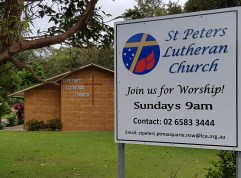
 St Peters Lutheran Church Port Macquarie