Good Friday Sermon by Pastor Mark Worthing.
St Peters Lutheran Church Port Macquarie
Inspiring people to LIVE a purposeful LIFE, growing TOGETHER in JESUS CHRIST
Good Friday Sermon by Pastor Mark Worthing.
Every Christian has a calling to publicly confess and speak of our faith in Christ and our faith in the Triune God, before others, before the world and even before governors and kings. This confession the Church in our day is called to make—our confession of faith—goes right back to the Lord Jesus himself.
So let’s take a closer look at this good confession that Jesus himself makes, as we heard in our Gospel reading.
We encounter Jesus here in the middle of his trial, before Pontius Pilate. There has been this back and forth with the religious leaders outside, but now we’re inside, behind closed doors, and the focus is very much just on Jesus and Pilate.
Pilate wants to cut straight to the chase, ‘Are you the King of the Jews?’
But like he often does Jesus is not too keen on answering questions directly. He responds in this sort of cryptic way, ‘Do you ask this on your own, or did others tell you about me?’ He immediately shifts the conversation onto his terms and it’s almost as if Pilate is the one under interrogation.
It seems that Jesus is trying to get back behind Pilate’s tough, matter-of-fact demeanor, and dig deeper, trying to engage Pilate about what really matters.
It reminds me a little of the way Jesus speaks to his disciples elsewhere: “What about you? Who do you say that I am?”
We can’t keep Jesus at arms-length forever and only be interested in information about him. It must become personal at some point, and Pilate, whether he like it or not, is having that encounter.
But Pilate doesn’t respond well. He is dismissive and scornful of Jesus’ question. It’s as if he’s saying, ‘Of course it’s others who have told me, I don’t care about your little Jewish squabbles, I’m not personally interested in whether you’re the king of the Jews or not, except that it’s beginning to cause me political problems and I want to sort it out. So–what have you done Jesus?
Again Jesus answers in an indirect and somewhat cryptic way, saying: ‘My Kingdom is not from this world. If my Kingdom were from this world, my followers would be fighting to keep me from being handed over to other Jews. But as it is, my kingdom is not from here’.
Now why does Jesus answer like this?
Pilate gets the implication. “So you are a King?” he says. For Jesus to say he has a kingdom is to admit he is a King. But perhaps Jesus answers like this because he knows that old rule of discussion and debate, about the need to define one’s terms. Pilate wants to talk about kingship, but he has in mind a very particular definition of what it means to be a King, which is about political strength, military action, and this worldly power.
And although Jesus is the true King, He is such a different sort of King. His kingdom has such a different character, that he can hardly name it as the same thing Pilate has in mind.
It comes from a whole other world, from above, from heaven, from God. And one thing this means then, that Jesus outlines here, is that his kingdom does not come and does not advance itself by human strength, not by political power and military might, and especially not by violence.
Jesus wants Pilate to consider that, if he were a King like the kings of this world, wouldn’t his followers be rising up in violent rebellion?
And yet they’re not! In fact when one of them did, Jesus stopped him and healed the one he had struck, because he’s an entirely different King, with an entirely different sort of Kingdom.
Now after this incredible statement it’s tragic that Pilate seems to miss all that and go back to the basic question, ‘So you are a King’. Pilate isn’t interested in these deeper questions and the nature of Jesus’ Kingdom, he just wants to work out if Jesus is claiming to be a King or not, and he wants to get on with the job.
But Jesus, in his graciousness and patience, comes at it from another angle, describing his Kingship and kingdom in another way. ‘For this I was born, and for this I came into the world, to testify to the truth. Everyone who belongs to the truth listens to my voice’.
Yes—Jesus is a king. And Jesus has a kingdom. But its primary concern is not land and wealth. It’s not bigger palaces and more luxury for the King and his court.
But notice this too, it’s primary concern is not in the first place even just making the lives of its subjects ‘better’ in worldly terms.
The primary concern of this King and this kingdom is truth, Jesus says. He’s come to testify to what’s real and what’s true.
Now this evidently grated with Pilate, as much as it still does with people in our day. Our human instinct is toward being pragmatic, even at the expense of the truth, finding what works, what’s relevant for me now today. But truth—well that can be in the too hard basket.
And this is also the temptation for us in the Church. It’s good for us to remember that although the Christian faith brings practical benefits in our lives, ultimately no one should be or become a Christian just because it works for them, but because it’s true.
Pilate’s final response though is the most dismissive and tragic of them all: ‘What is truth?’ And he simply walks away.
And yet Pilate’s encounter with Jesus had meant enough for him to be able to go back out and say, ‘I find no case against him.’
Although Pilate eventually let them have their way and crucify Jesus, his encounters with Jesus did mean enough that the inscription above him on the cross read ‘This is the King of Jews’, and Pilate would say, again somewhat mysteriously and cryptically: ‘what I have written, I have written’.
Little did Pilate know that the one in front of him was not only the true King of the Jews, but the very Son of God in human flesh, come to save the world.
Little did Pilate know, that the one who said he came to testify to the truth, was in fact himself the way, the truth, and the life, who came from heaven to earth, full of grace and truth.
Little did Pilate know that the one he sent to be crucified, had come to lay down his life for the Jews. For Pilate, for the world…and for each one of us.
And as he died and rose again from the dead, as he ascended to his Father, he has ushered in this kingdom, and has invited us into it. Jesus made his good confession before Pilate, as he went the way of the Cross for us. Let us be prepared to make our good confession before the world, of Christ, our King, the crucified and risen Saviour of the world. Amen.
Good Friday
John 19:16b-42
There is no escaping the brutality of the crucifixion. There is no way to read today’s text without a shudder. The Romans were efficient at putting people to death in ways that were very public and excruciatingly painful. And that is the kind of death Jesus willingly accepted. For us.
And his mother was there. Did you pick that up. We almost read past it, as if she is just part of the background, but the woman God chose to bring Jesus physically into this world, to feed him, nurse him, rear him; is there to watch him die in agony. There is nothing pretty or beautiful about this story. And John doesn’t hold back. He was there too. The only of the disciples who was not in hiding. And he wants the reader to know and feel what happened.
It is a relief when Jesus says the words, ‘It is finished.’ We want it to be over. Surely he has suffered enough. His mother has suffered enough. The thieves beside him have suffered enough. The reader has suffered enough. Then finally Jesus says, ‘It is enough. It is finished.’ He has done what he came to do. And he bows his head and dies.
But we are not done yet. John has more to tell. The legs of the thieves on either side of Jesus are broken. This would have been done with a large mallet, so that they can no longer push themselves up against the nails through their feet to get air into their lungs. This will hasten their death, suffocating them. This happened, John tells us, because the authorities do not want the inconvenience of people still being tortured to death when the holy day of Passover is about to begin.
It was after all, as John tells us, the Day of Preparation. That was the day before the Passover in which lambs were sacrificed in preparation for the Passover meal.
The alert reader will recall that at the beginning of John’s Gospel, John the Baptist pointed to Jesus and proclaimed: ‘Look, the Lamb of God who takes away the sin of the world!’ Jesus even goes before the high priest, for every sacrificial lamb had to be approved spotless by a priest, and he is approved for death – approved by the high priest Annas himself, the one who said it is better for one man to die for the whole people.
And now here Jesus is, the Lamb of God, being sacrificed for us all.
But what we are hearing, what we are seeing, is in stark contrast with the beautiful songs we often sing about the ‘Lamb of God.’ The brutality of it all is relentless. So after Jesus says, ‘It is finished,’ the thieves’ legs are broken, each thief, one leg at a time. Then the soldiers come to Jesus and find he is already dead. But even in death the brutality continues. A spear is thrust into his side – just to be certain.
And Mary is still there. It is difficult to fathom the courage and love it must have taken for Mary to stay there with her son to the very end. But she did.
And that’s the story of Good Friday. And there is nothing pretty about it. But somehow, through this brutal death, through the pain Jesus endured, something shifted. The world changed. The world became somehow less brutal, and more filled with hope.
Something shifted. The world changed through that horrendous death.
And the change begins to be seen almost immediately.
We spot it first in what seems to be a minor post-script to the account of Jesus’ horrendous death. John tells us about two members of the Sanhedrin, the Jewish ruling council that conspired to send Jesus to Pilate and to his death, two men who muttered only mild questions about the rightness of what the council was doing, two men at whose hearts Jesus’ message had long tugged. But they were too fearful to speak up. John tells us that now, when all is lost, they find the courage to publicly come out as followers of Jesus.
Something has changed. There has been a shift in reality.
The disciples you will recall, with the notable exception of John and a few of the women, are in hiding. Everyone is feeling the bitter sting of defeat. No one is any longer expecting Jesus to overthrow the Romans or to usher in any kind of kingdom. And then, of all times, Joseph of Arimathea and Nicodemus step forward.
Nicodemus?
Yes, Nicodemus.
You remember him. He showed up early in John’s Gospel, at night when he would not be seen, asking Jesus questions. It was Nicodemus to whom Jesus explained that ‘God so loved the world that he sent is only son, that everyone who believes in him would have eternal life.’ It was Nicodemus to whom Jesus said a person must be ‘born again’ or ‘born from above.’
It was Nicodemus, who when the Sanhedrin first began to plot against Jesus, meekly suggested a person should not be judged without a hearing. And he was mocked with a suggestion that he, too, was a Galilean, and a follower of Jeus (7:50-52). And Nicodemus went quiet and remained quiet.
Until Jesus was crucified.
And Joseph of Arimathea. He was wealthy. He was a member of the ruling council. He was important enough to go straight to Pilate, the Roman governor, and ask for the body of Jesus.
Jesus is dead. The disciples are in hiding. The movement is over. All hope is lost. Then two secret followers with everything to lose come forward, when there was no hope. Jospeh provides his own tomb. And Nicodemus comes with a hundred pounds of ointments and spices to prepare the body.
They came forward when there was nothing to gain and everything to lose. And they did not so quietly or meekly, but in a big way. They went straight to Pilate. They took ownership of Jesus’ body. They put in in one of their own tombs, in a prominent place. They brought an expensive excess of ointments and spices to anoint the body, that it would have taken much effort for the two of them to carry to the tomb. It was a very public, very bold and very dangerous identification with Jesus.
Not only that, but here were two important Jewish leaders, people who would never make themselves unclean by touching a dead body, and they personally prepare Jesus’ body for burial, which they would not have been able to complete before the official start of the Sabbath and Passover. So they would not be celebrating Passover with their families that year, and everyone would know why. It would be a major scandal in their families and communities. But they did it.
So what happened? Why did they suddenly act.
Something had shifted. The world had changed. And two powerful men with everything to lose suddenly throw caution to the wind.
It was starting.
It would be a long dark Saturday before Sunday morning finally came. Before the disciples and the whole world would began to understand the enormity of what had occurred that Friday afternoon.
But the death of Jesus had already changed everything. And in the surprising action and courage of Joseph and Nicodemus we see the shift already beginning. We see the cracks in the walls of darkness, fear and despair appearing.
Jesus freely went to the cross. He allowed himself to be put to death in one of the most brutal ways imaginable.
We still cringe when we read the story.
But somehow, in the midst of the brutality, the pain, the suffering – the world changed.
God himself in the person of Jesus Christ had not only come to live among us, as John tells us at the beginning of his story, but now God in the person of Jesus has embraced human pain and suffering, dying at human hands, dying among us and for us.
God freely suffered with us and for us. God felt our pain, literally.
And in the midst of darkness, darkness itself cracked. The light of Christ breaks in – and the world changed.
Those at the cross felt it. Joseph and Nicodemus felt it. And soon, the whole world would begin to hear the news. One man’s brutal death had shifted our reality. One man’s painful execution had changed everything.
And here we are, two thousand years later, on Good Friday, still contemplating the depth of what happened on the cross, and how it changed the world – and how it continued to change each of us.
Amen.
Pastor Mark Worthing.
A survey taken overseas asked people about what question they would like to ask God. Most of those asked, said they’d ask God “Why is there suffering?” For many people, suffering makes it very hard to believe in God. The good news of Good Friday is that God didn’t stay aloof from suffering, but shared it with us. God Himself is our co-sufferer who experienced suffering first-hand with us and understands what it’s like to suffer.
A suffering God is the most profound response to human suffering there is. Who knows how much suffering God has had to bear because of the way our sins, faults and failures have hurt Him? Christ’s passion, dying and death are the point at which divine and human suffering meet. It is not enough to know God in His glory and majesty unless we have first got to know our Creator in the suffering of His Son on Good Friday. There can be no pain worse for a parent than to see his son suffer and die in a terribly cruel way, as God the Father did on Good Friday.
“The crucified Jesus is the only accurate picture of God the world has seen (A. Baker).” By means of Christ’s suffering on the cross for you, God is saying to you, “This is where you ought to be. Jesus, My Son, hangs there in your stead; His tragedy is the tragedy of your life. You are the rebel who should be hanged on the gallows. But lo, I suffer instead of you, and because of you, because I love you, despite what you are. My love for you is so great that I meet you there with my love, there on the cross. I cannot meet you anywhere else. You must meet me there, by identifying yourself with the One on the cross.”
Good Friday was when God took His own medicine. At Calvary God submitted to the conditions He laid down for us and seemed to suffer defeat. But instead God defeated death with death, and our suffering with His own suffering. By entering into our experience of suffering, Jesus can comfort us in all our distresses like no one else can. Over the centuries, Christians have kept coming back to the cross of Christ for comfort, strength and hope. You see, the cross of Christ has released into human history the most powerful force for regeneration and renewal the world has ever seen. It is the pinnacle of everything Christ achieved for us on earth. There Jesus took on responsibility for all our failures, took them as His own and took the punishment they deserve. Instead of judging us, Christ was judged in place of us, with the ungodly men being crucified next to Him, so that we might be acquitted and set free from our sin.
Therefore, as we read in Romans 8:1, “There is no condemnation for those who are in Christ Jesus.” That’s the unsurpassed good news Good Friday made possible. There can be no true love without a willingness to suffer for and with those we love. We go to the Cross of Christ for our definition of love. “This is how God showed His love for us: He sent His only Son into the world that we might have life through Him. This is what love is: it is not that we have loved God, but that He loved us and sent His Son to be the means by which our sins are forgiven (1 John 4:9-10).”
Our crucified Saviour continues to attract the devotion and wholehearted commitment of millions of people because His suffering for everyone on the Cross is the greatest demonstration of love the world has ever seen. At the Cross we see a totally other-centred love. Instead of focussing on His own pain, Jesus shows love for His executioners by asking God to forgive them and welcomes the penitent thief being crucified next to Him into Paradise. Now Jesus shows His love for His mother by making sure she is cared for.
Mary is there with St John, “the disciple whom Jesus loved”, because they cannot bear to be anywhere else. At the Cross St John was overwhelmed by our Lord’s love for him, and represents all of us who love Jesus and are forever grateful for His love for us. John now places himself at the service of Jesus. Mary sees all the hope she’s placed in Jesus now gone. How sad it is that Jesus’ brothers aren’t there. Maybe they’re too scared to be seen with Him. We wonder what’s going through Mary’s mind. Perhaps Mary is haunted by the words of Simeon: “and a sword will pierce through your own soul also.”
Thinking more of His mother’s pain and anguish than His own suffering, Jesus now entrusts His mother to the disciple He knows will care for her best of all. “Woman, here is your son” Jesus says to Mary. In doing so, Jesus adopts St John as His brother. Then to John He says, “Here is your mother.” Jesus now gives both of them a new future in the community He has established through His cross and resurrection. His death creates a new set of relationships, bringing together as Christian siblings, those previously unrelated.
John and Mary are the first two members of Christ’s new family, the Christian Church. Jesus had promised to His followers who lose their family members in this life because of Him, He will provide them with Christian siblings. “Truly I tell you, there is no one who has left house or brothers or sisters or mother or father or children or fields, for my sake and for the sake of the good news, who will not receive a hundredfold now and in this age, houses, brothers and sisters, mothers and children…and in the age to come, eternal life (Mark 10:29-30).”
Our Lord will now love Mary through John’s love for her and He will show His love for John through Mary. Relationships with fellow Christians have often been deeper than with members of one’s own family. Jesus brings His blessings to us also through our fellow Church members. “We do not live for ourselves only, and we do not die for ourselves only. If we live, it is for the Lord that we live, and if we die, it is for the Lord that we die. So whether we live or die, we belong to the Lord. For Christ died and rose to life in order to be the Lord of the living and of the dead (Romans 14:7-9).” The abundant life Jesus offers us is life together with our fellow Christians, where Christians encourage, serve, comfort and are devoted to each other. Our ties with our fellow Christians are so good because they continue forever beyond death.
Our Lord’s next word from the cross—“I thirst!”—is the shortest of His seven words, and the most thoroughly human. I’m sure you can recall a time when you were desperately thirsty and know how desperately you longed for your thirst to be quenched. Jesus now acknowledges His own suffering. In doing so He comes closest to us as a fellow human being. Thirst was one of the worst agonies of crucifixion. Those about to die often asked for a drink just before they passed away. Jesus’ plea is something even a child in need of a drink in the middle of the night can understand.
Jesus became one of us in every way so that He can make us one with Him. When we suffer today, Jesus can sympathise with us, knowing first hand what it’s like to suffer. The soldier who gave Jesus a drink showed him the only act of kindness Jesus received on the Cross. Today we meet Jesus’ thirst by satisfying the thirsty around us: “I was thirsty and you gave me to drink …Inasmuch as you have done it to one of the least of these my brothers or sisters, you have done it to me.”
The drink Jesus received revived Him enough so He could utter His cry of victory: “It is finished!” “It is finished” means that Christ’s sacrifice for us is complete. Christ has won the victory over sin, death and the devil. Receipts from that time have been found with these words written across them, meaning the account has been PAID IN FULL. Jesus has paid in full the debts created by our sins. We can add nothing to our salvation, except to thank and praise Jesus forever for all He has done for us. Love at its best defeated evil at its worst. God’s masterpiece is now complete. Christ’s Cross is His victory for us, and Easter is the revelation of that victory. The events of Good Friday are permanently effective for all time. The Cross sanctifies our pain and sorrow so that it can bring blessings into the lives of others. The Cross of Christ enables all who love God to suffer in hope, knowing that “all things work together for good for those who love God (Romans 8:28).”
In a chapel in Europe hangs a painting of Christ on the Cross with the words printed under it: “All this I did for you. What have you done for me?” One summer afternoon, the Count of Zinzendorf entered the chapel and was immediately drawn to the painting. He saw love in the pierced hands, love in the bleeding brow, love in the wounded side. Then he read the caption below. Sobbing and weeping, he gave his life to Jesus, whose love had not only saved his soul, but also conquered his heart. The Count of Zinzendorf wrote our hymn “Jesus, your blood and righteousness / my beauty are, my glorious dress”, and spent the rest of his life telling others about the love of Christ revealed so fully on the Cross.
“Love so amazing, so divine / demands my soul, my life, my all.” Amen.
The Grace and Peace of our Lord Jesus Christ be with you. Let’s join in a word of prayer: Loving God our Father, today we gather with all those who mourn over the sin of humanity. Sin that required the sacrifice of a sinless Son of God, our Saviour Jesus Christ. Help us to experience, in a tangible way, Your presence in our lives and our worship. Open our hearts and minds that we may once again be drawn to the ‘lamb of God who takes away the sin of the world’. Gracious heavenly Father, hear our prayer for the sake of our risen Saviour and Lord, Amen.

I remember an image on Facebook that quoted Zig Ziegler.
F-E-A-R has two meanings …
Forget Everything And Run
Or
Face Everything And Rise.
Today especially, we discover the reality of what Ziegler shares with us. Good Friday vividly shows the contrast between our Saviour Jesus Christ, the believers who followed him, and the society who determined to destroy him. And it poses a unique opportunity for us to face everything that would try to destroy our faith, and rise above it to preserve our trust in God the Father, the Son and the Holy Spirit.
Our Lord Jesus Christ faced everything when he sacrificed himself in crucifixion. He protected us from all that separates us from God, by being separated himself when he covered himself with our sin. He opened eternity for us when he spent three days confined to hell offloading all those sins in a place designed for Satan and his dominion. He made all the difference when he was raised again in victory and promised to be with us until the very end of the age. We have been redeemed from destruction when God entered humanity in his Son our Saviour. We received life eternal when Jesus died on a cross as a sacrifice for us.
In Matthew’s Gospel, we discover a description of the redemption we have in Christ Jesus. The temple curtain was torn in two when Jesus breathed his last. God removed every obstacle between people and himself. God demonstrated that the death of Christ Jesus opened up for us access to the Holy of holies—to the very presence of God.
The writer of Hebrews recalls this event, “we can boldly enter heaven’s Most Holy Place because of the blood of Jesus.”
John’s Gospel tells us that when Jesus was baptised in the Jordan River, God spoke to him, “You are my Son, whom I love; with you I am well pleased.” These were words of promise and victory. When Jesus died on the cross, he cried out the words “It is finished”, this too was a cry of victory. Jesus accomplished what God, his Father, had sent him into humanity to do.
Jesus faced everything and overcame the final temptation in accepting death on our behalf. Like others who face everything and rise. It is like the athlete who enters a marathon race with the single-minded intention of both reaching the finishing line and coming in first. It is like the student who finally reaches the goal of graduation with a degree after years of study. It is like the author or artist, who after years of research and struggle finally complete their masterpiece, their most significant and enduring work. It is like a survivor after great suffering who recuperates completely.
For John the words of Jesus, “It is finished,” are the epitome of Christ’s life and ministry; the words are spoken by the King of kings on his throne of pain, which was the cross.
Jesus won the victory over sin, evil and death by willingly, and lovingly allowing himself to submit to these powers. In so doing, he defeated them. People no longer need priests or holy men to stand between us and God. Because of Jesus’ death on the cross, we can boldly enter into God’s presence. As the writer of Hebrews tells us, ‘dear brothers and sisters, we can boldly enter heaven’s Most Holy Place because of the blood of Jesus. This is the new, life-giving way that Christ has opened up for us through the sacred curtain, by means of his death for us.’ Because he faced everything and rose to the challenge.
As we confront the gruesome death of Christ Jesus, we also confront our response to the new relationship we have with God through his sacrifice. We can determine not to take God for granted. Not to live our lives as if Jesus had never entered humanity. But instead to celebrate our new relationship with God every day through the words we use, the actions we take, and the attitudes we adopt. We can face everything we encounter in our Christian life, and we can rise above the temptation and challenge to live with joy in our lives.
We are all part of God’s plan. We are all destined for a place in eternity with our Saviour. We only need accept that plan. And let the Holy Spirit guide us day by day, step by step, bravely toward our destiny as children of God.
It will not be easy, and we will never be perfect, but we can be confident that God is not finished with us yet.
It is clear to me that if I am to faithfully fulfil my part in God’s plan, I need to be steady in my relationship to God, Father, Son and Holy Spirit. I can do this by remaining in fellowship with Christ Jesus and with others in our community who also believe in Jesus as Saviour.
As Hebrews puts it, ‘Without wavering, let us hold tightly to the hope we say we have, for God can be trusted to keep his promise. Think of ways to encourage one another to outbursts of love and good deeds. And let us not neglect our meeting together, as some people do, but encourage and warn each other, especially now that the day of his coming back again is drawing near.’
By his death on the cross, Christ Jesus faced everything and rose to his rightful place in eternity. He will return once more, briefly, to bring all things to conclusion in the plan of God our Father. Yes, “It is finished,” But it is far from over. By his death, life has begun.
Each day we live, we are closer to the day that Christ Jesus will return in glory. Whether he calls us home, or he returns, we will glorify him with our knees bowed, our hearts filled with song, and our lives surrounded with his love. And for this, our only response can be “Thank you Jesus!”
As we face every difficulty in our lives, our Saviour is calling us to face everything and rise, and to respond by living our salvation; by loving each other, caring for those around us, as we let it begin with us, in our worshipping community.
May the Holy Spirit set our hearts and lives ablaze for Christ Jesus to the Glory of God our Father, and may the grace and peace of God keep our hearts and minds in Christ Jesus. Amen.
Rev David Thompson.
|
The Grace and Peace of our Lord Jesus Christ be with you all. Let’s join in a word of prayer: Loving God and Father, today we gather with all those who
mourn over the fall of humanity. Sin that required the sacrifice of a sinless Son of God, our Saviour Jesus Christ. Help us to experience, in a tangible way, Your presence in our lives and our worship today. Open our hearts and minds to your plan for our lives that has been worked out through Christ Jesus our Lord, in whose name we pray. Amen.
Recently, I revisited Max Lucado’s book “He chose the nails”. Max encourages us to encounter the mysterious gifts that Jesus chose to give us through his sacrifice. The gifts of Good Friday and Easter Morning are the most precious gifts any person could ever receive because they cost God so much to give. The Apostle John records those words of John 3:16: ‘God loved the people of the world so much, he gave his only son, so that everyone who believes in him will have everlasting life and not perish.”
God did this for us—just for us—because he loves each one of us so much.
When Jesus was taken from his disciples, abused and bound, he knew the humility that sin binds to all people. Yet Jesus chose to become one of us.
When Jesus stood falsely accused before the chief priests and teachers of the law, he knew the guilt that sin cries out against all people. Yet Jesus chose to forgive us.
When Jesus stood before the crowd in the hands of the soldiers of the Roman Governor, he knew the rejection and isolation that sin brings upon all people. Yet Jesus chose to invite us into his holy presence in eternity.
When Jesus felt the hatred of those crying out for him to be crucified, he knew the cruel sentence that sin brings upon all people. Yet Jesus chose to love us forever.
When Jesus suffered the lash and the cross, he knew the awful suffering that sin casts upon all people. Yet Jesus chose to give us the victory in his own crucifixion.
And yet, as Chad Bird writes in his book: Finding God in the Most Unexpected Places:
The glory of God was revealed on the cross of crucifixion. And yet ‘seeing God on the cross, we do not see. That is, unless our spiritual eyes have been transferred to our ears. Unless we see him through the prophecies of Isaiah about the Servant who would be “despised and rejected by men; a man of sorrows and acquainted with grief; and as one from whom men hide their faces”. (Isa 53:3)
The Servant who would be “pierced for our transgressions; he was crushed for our iniquities; upon him was the chastisement that brought us peace, and with his wounds we are healed.” (v 5) If the Word of God, not the vision of our eyes, defines what is real, then we shall really see God on the cross. We shall bask in the glory where no glory is to be seen. On the cross and only on the cross, the scales shall fall from our eyes so that we finally get it: ‘God chose what is foolish in the world to shame the wise; God chose what is weak in the world to shame the strong; God chose what is low and despised in the world, even things that are not, to bring in the presence of God’. (1 Cor 1:27-29)
The Cross is God’s veiled unveiling. It is his absent presence. It is heaven dressed up as hell. The cross defines how God has always worked and always will. This is radical life-changing realization. Beginning in Genesis, and continuing even now in our own lives is the God of the cross. … He conquered the cosmos by suffering defeat in death. He made his life our own, by letting humanity murder him’. (‘Your God is Too Glorious – Finding God in the most unexpected places’ by Chad Bird, Baker Books, page 24)
So here we are together, honouring the sacrifice of our Lord and Saviour Jesus Christ, Son of the Living God. A sacrifice through which Jesus offers the precious gifts witnessed by this holy week.
We didn’t see the star in the sky on the night he was born in our humanity. We didn’t hear the witness of shepherds about the visit of angels. We didn’t see him turn water into wine, or calm a storm, or feed 5000 with two fish and five loaves. We haven’t seen him teaching and healing in the Temple. We haven’t seen him being questioned by the religious leaders, and the Roman Governor. We haven’t seen him being whipped for our transgressions. We haven’t seen him ridiculed by the pagan soldiers. We haven’t seen him hanging lifeless on a cross. And yet, we believe. As Jesus would say to Thomas after his resurrection, “You believe because you have seen me. Blessed are those who believe without seeing me.” (John 20:29 NLT)
We have learned from the ancients of faith, that God prepared the world through his prophets for the arrival of a Saviour, a Messiah. The arrival they only hoped for. The arrival we have heard about from the Scriptures that witness what we have not seen, and yet believe.
We have received the encouragement from the Apostles that the faith we have in our Saviour is as precious, as valid, as powerful, as important as the faith of the Apostles, the Prophets, the Ancients of the Faith.
We have cherished the reality of Scripture, received from our nearer forefathers of the Reformation, that we are in a right relationship with God our Father, through the faith we have in Christ Jesus who offered forgiveness from the cross.
When Jesus whispered from the cross that “It is finished,” we can be assured that it was the end of the old. And a new beginning of God’s presence among us. The beginning of life in the presence of God’s eternity. The call to discipleship, and the unfolding of history into the future from creation to Apostles to modern Christianity.
As Jesus said, “If any of you wants to be my follower, you must give up your own way, take up your cross daily, and follow me. If you try to hang on to your life, you will lose it. But if you give up your life for my sake, you will save it. If anyone is ashamed of me and my message, the Son of Man will be ashamed of that person when he returns in his glory and in the glory of the Father and the holy angels.” (Luke 9:23–27 NLT)
The gifts that Jesus chose to give us in his death and resurrection show us the unfolding plan of God for us all. With a sure conclusion of the utter defeat of the devil; and the ultimate victory of God’s plan. A plan for those through time and place who receive Christ Jesus, those who believe in his name, those to whom God has given the right to become his children.
We are part of God’s ultimate plan in the ultimate victory of Christ Jesus. Because Jesus Christ fulfilled God’s plan for salvation, as he cried, “My Father, if it is possible, may this cup be taken from me. Yet not as I will, but as you will.”
For us now, in our generation, in our time, and in our place, we are called to be faithful in living the faith we have received by the Holy Spirit working in word and sacrament.
We are warned from Hebrews, ‘Without wavering, let us hold tightly to the hope we say we have, for God can be trusted to keep his promise. Think of ways to encourage one another to outbursts of love and good deeds. And let us not neglect our meeting together, as some people do, but encourage and warn each other, especially now that the day of his coming back again is drawing near.’
As we approach the conclusion of our age, and the revealed victory of God’s plan for life, we are given the task to hold onto the faith we have received. To witness that faith by our actions, our attitudes and our words, as we live out our part of God’s plan as children of God who can be trusted. To encourage each other, as we all face those times when we are tempted to doubt God’s care for us.
To find enjoyment, fulfillment, and purpose in meeting together in fellowship as our hearts sing together the praises of our Saviour who died for us.
This is especially important now that we are closer to our Lord’s return than ever before in history. When we witness events and hostilities that surely point to the end of times. As one sign recently said, ‘one in hundred years drought, fire, flood and pandemic, all in 18 months.’ And yet, we realize as Jesus tells us clearly that only the Father knows when he will wrap up this age, and usher in a new age of peace and love. And that will be wonderful.
Because of Good Friday, we can hear the words of Hebrews with a new direction in our life, ‘dear brothers and sisters, we can boldly enter heaven’s Most Holy Place because of the blood of Jesus. This is the new, life-giving way that Christ has opened up for us through the sacred curtain, by means of his death for us.’
And so, today, as we grieve the suffering and death of our Saviour, and we prepare to celebrate His awesome resurrection, let’s hold onto these words of Hebrews, ‘without wavering, let us hold tightly to the hope we say we have, for God can be trusted to keep his promise.’ And may the grace and peace of God keep our hearts and minds in Christ Jesus. AMEN.
Rev. David Thompson.
Readings for Good Friday
 14 Many were amazed when they saw him—beaten and bloodied, so disfigured one would scarcely know he was a person. 15 And he will again startle many nations. Kings will stand speechless in his presence. For they will see what they had not previously been told about; they will understand what they had not heard about.
The Grace and Peace of our Lord Jesus Christ be with you all. Let’s join in a word of prayer: Loving God and Father, today we gather with all those who mourn over the fall of humanity.
Our Lord Jesus counseled the Apostle Thomas after his resurrection “Because you have seen me, you have believed; blessed are those who have not seen and yet have believed.” (John 20:29 NIV)
The Epistle of Hebrews encourages us that ‘faith is being sure of what we hope for and certain of what we do not see. This is what the ancients were commended for. They were all commended for their faith, yet none of them received what had been promised. God had planned something better for us so that only together with us would they be made perfect.’ (Hebrews 11:1-2,39–40 NIV)
And Hebrews goes on to say that ‘ since we are surrounded by such a great cloud of witnesses, let us throw off everything that hinders and the sin that so easily entangles, and let us run with perseverance the race marked out for us. Let us fix our eyes on Jesus, the author and perfecter of our faith, who for the joy set before him endured the cross, scorning its shame, and sat down at the right hand of the throne of God. (Hebrews 12:1–2 NIV)
Then the Apostle Peter wrote ‘To those who through the righteousness of our God and Saviour Jesus Christ have received a faith as precious as ours: Grace and peace be yours in abundance through the knowledge of God and of Jesus our Lord.’ (2 Peter 1:1–2 NIV)
So here we are together, honouring the sacrifice of our Lord and Saviour Jesus Christ, Son of the Living God. We haven’t seen him teaching and healing in the Temple. We haven’t seen him being questioned by the religious leaders, and the Roman Governor. We haven’t seen him being whipped for our transgressions. We haven’t seen him ridiculed by the pagan soldiers. We haven’t seen him hanging on a cross. But we believe.
We have learned from the ancients of faith, that God prepared the world through his prophets for the arrival of a Saviour and Messiah. The arrival they only hoped for, but we have heard about from the Scriptures that witness what we have not seen, but believe.
We have received the encouragement that the faith we have in our Saviour is as precious, as valid, as powerful, as important as the faith of the Apostles, the Prophets, the Ancients of the Faith. Even our nearer forefathers of the Reformation who quoted the reality of Scripture that we are in a right relationship with God our Father, through the faith we have in Christ Jesus who sacrificed himself on the cross of crucifixion.
When Jesus whispered from the cross that “It is finished,” we can be assured that it was the end of the beginning of God’s presence among us, and the beginning of life in the presence of God’s eternity.
In the game of chess, there are three distinct patterns of the game. The opening, the middle game and the end game.
The opening when chess pieces are moved into place with purpose and plan, containing distinct advantages and weaknesses. The middle game when pieces are exchanged, and vulnerabilities are capitalized upon while advantages are championed. And the end game when the ultimate conclusion is played out with a sense of predestination, that both sides really expect.
Life is certainly not a game, but life does have similar patterns. We see from Scripture the opening pattern of life – with creation, then failure then flood then re-creation.
We see the middle pattern with selection of a man of faith, Abraham, and a covenant relationship with a nation, again failure and judgment and revival, played out over generations with the foresight of prophets and the actions of kings. Empires and nations rising and falling. We see the conclusion of the middle game with the birth, life and crucifixion of God’s Son, who entered humanity to usher in a new covenant between God and the people he loves so much.
And we see the beginning of the end game pattern with the resurrection, the call to discipleship, and the unfolding of history into the future from Apostles to modern Christianity.
All with a sure conclusion of utter defeat on the part of the devil and people of unfaith; and the ultimate victory of God’s plan. A plan for those through time and place who received Christ Jesus, those who believed in his name, those to whom God gave the right to become his children.’
We are part of this end-game strategy of life that God has willed when he scooped some dust together and breathed life into humanity. Because Jesus Christ fulfilled God’s plan for salvation, as he cried, “My Father, if it is possible, may this cup be taken from me. Yet not as I will, but as you will.”
For us now, in our generation, in our time, and in our place, we are called to be faithful in living the faith we have received by the Holy Spirit working in word and sacrament.
We are warned from Hebrews, ‘Without wavering, let us hold tightly to the hope we say we have, for God can be trusted to keep his promise. Think of ways to encourage one another to outbursts of love and good deeds. And let us not neglect our meeting together, as some people do, but encourage and warn each other, especially now that the day of his coming back again is drawing near.’
As we approach the conclusion of our age, and the revealed victory of God’s plan for life, we are given the task to hold onto the faith we have received. To witness that faith by our actions, our attitudes and our words, as we play out our part of life as children of God who can be trusted.
To encourage each other, as we all face those times when we are tempted to doubt that final victory lies with those who believe.
To find enjoyment, fulfillment, and purpose in meeting together in fellowship as our hearts sing together the praises of our Saviour who died for us.
This is especially important now that we are closer to our Lord’s return than ever before in history. When we witness events and hostilities that surely point to the end of times. And yet, we realize as Jesus tells us clearly that only the Father knows when he will wrap up our game of life, close up his board of this age, and invite us to his after party at the great feast before he reveals whatever next he has instore for us. And it will be wonderful.
Because of Good Friday, we can hear the words of Hebrews with a new direction in our life, ‘dear brothers and sisters, we can boldly enter heaven’s Most Holy Place because of the blood of Jesus. This is the new, life-giving way that Christ has opened up for us through the sacred curtain, by means of his death for us.’
As we face every difficulty in our lives, our Saviour is calling us to respond by recognising his presence with prayer, and living our salvation; by loving each other, and caring for those around us; by reaching out to someone who hasn’t yet confronted the death of our Saviour. Who hasn’t yet accepted the salvation that our Saviour offers from his glory through his resurrection.
And so, today, as we grieve the suffering and death of our Saviour, and we prepare to celebrate His awesome resurrection, let’s hold onto these words of Hebrews, ‘without wavering, let us hold tightly to the hope we say we have, for God can be trusted to keep his promise.’ And may the grace and peace of God keep our hearts and minds in Christ Jesus. AMEN.
Rev David Thompson.
WHY DID JESUS DIE?
: Good Friday
Today I’m beginning with a simple question; Why did Jesus die?
What are some of the thoughts that come to your mind when  you hear that question; Why did Jesus die?
Did Jesus die because we have an angry God and he was the sacrifice that was needed to appease God’s anger? Is God’s wrath the problem?
Or would you put it more like this; Jesus died to save us from our sin. What does it mean that Jesus saves us from our sin?
These questions aren’t meant to make you feel as though you’ve got to get the right answer or otherwise you’re wrong. I’m just asking questions to get us thinking about what Jesus did for us on the cross.
We take a whole day off work; or we used to, to stop what we’re doing to remember this most important event in our history; Jesus crucifixion. Why did Jesus die?
You’ll be pleased to know that Jesus didn’t die to save us from an angry God. His Dad isn’t angry. Actually his Dad is the personification of love; it’s his very nature, he can do no other. Whatever he does is love. That reminds me of 1 John 4:16 ‘God is love’.
Isn’t that Good News, “God is Love” and then John continues; “and all who live in love live in God, and God lives in them.” (1 Jn 4:16) What a wonderful relationship John is seeking to describe. But wait there’s more; “Such love has no fear.” (1 Jn 4:18) Did you hear that, ‘no fear’. “Such love has no fear, because perfect love expels all fear.” (1 Jn 4:18)
The perfect love mentioned is God, who’s very nature is love. It’s not just a character quality with him, it is who he is; love incarnate.
John reminded his readers of this earlier in his letter; “We know what real love is because Jesus gave up his life for us.” (1 Jn 3:16) Wow did you notice that John gave part of the answer to our question; Why did Jesus die? Jesus gave up is life; in other words died, so that we might know what real love is, God’s love, his very person.
So at the heart of the cross is love, God’s love, in Jesus, reaching out to who?
I think God’s love is reaching out to those who don’t believe it, that they are loved by him. God’s love is reaching out to those who don’t feel loved, to those who feel they have to prove themselves. God’s love is reaching out to those who think along these lines; ‘if I don’t act nice people won’t like me, let alone love me.’ Or thinking like this; ‘You only respect those who earn your respect.’
Jesus is reaching out to those who live in fear, by fear, through fear. To those who think they have to prove themselves. To those who seek to find their answer to fear by taking control themselves.
Remember earlier I said; Jesus died to save us from our sin. Sin is what I’ve been striving to describe to you. Sin isn’t the bad things we do as much as the fact that we are born into this world not knowing we are loved. We are born into a world of fear, a world of so many insecurities.
Part of the fear is we have sought to answer our fears by taking control of our lives. I shape my identity through what I do and that other people speak well of me. And the ones who don’t, don’t count. I reject them, but that leaves me with a nagging fear; who’s rejecting me.
Have you ever noticed what a power the fear of rejection is; the need to be accepted, valued, wanted?
My greatest sin is when I trust in my successes to define me, to make me feel safe. My greatest sin is found in the things I feel make me a good person, because they’re what I trust in. Here is my answer to this all-pervading fear.
Why are these my greatest sin? Because they become the very things that stop me from knowing God’s love for me. I’d love to have a dollar for every time someone has said a phrase like this; ‘God would like me, I’m a good bloke. I won’t go to hell, I’m a good person’. And you know what; I’d say without exception everyone who ever said this to me was a good person. They were fun to be with. They were loyal, thoughtful, people of character.
And without exception they all doubted that God could be trusted. Actually most of them doubt God’s very existence. They didn’t sense that he loved them, that he was over the moon about them, that he’d go to hell and back to love them. They would say to me; ‘If God was real, why is the world in such a mess, why is there so much suffering and pain. God can’t be real and if he is we’re not interested.’
Here is why Jesus died on the cross; he wants to love you. He want’s your life, actually he wants you, to be a living expression of love, just as his life is. Remember love isn’t simply a character quality of God, it’s his very nature, it’s who he is. Whatever he does is love, he can act no other way, it is who he is.
Would you say that of your life?
That’s Jesus goal, hope, dream. That as you discover and grow in his love, he is allowed to re-create you as a person who is shaped by his love, that your identity is wrapped up in his love, that fear is banished, replaced by this wonderful all-pervading sense of being loved. Jesus’ goal, his hope, his dream for you is that your life is a living expression of the love in your life, the love he has for you. The love he has for you flowing into every area, into every aspect because now, in Jesus, it’s become who you are; wow!
Do you notice that has nothing to do with you being better than anyone else. It has nothing to do with you proving your worth through what you do; because that ends up putting people down. They feel the need to prove themselves and soon we’re competing; who’s top dog.
Why did Jesus die?
Jesus was born, lived and died to create trust in his Father, to create love in us, a love which goes beyond a character quality to being the very essence of who we are so that when we act, it’s an act of love, because like Jesus, we are living true to who we are.
That’s why Jesus didn’t jump in and stop Adam and Eve from talking with the devil, God’s goal, hope, dream is that we love as we are loved. That we live from the core of who we are; loved. Jesus isn’t interested in robots always do what they are programmed to do. Jesus is after a genuine relationship of love.
Can you trust this guy with your life; with your sexual choices, with your financial choices, or will he screw you? Is he just in it for what he can get out of it?
What does Jesus; his life, death and resurrection say to you?
Today we are reminded that Jesus poured out his life for these people only to be abandoned, betrayed, beaten, ridiculed, laughed at, nailed to a cross to prove to everyone what a joke he was. Jesus was deliberately nailed to a cross to prove to everyone that he was cursed by God.
They mocked Jesus; ‘come off the cross and we’ll believe you. Save yourself, if you can’.
But Jesus doesn’t come off the cross, that would have just cemented us in fear. Jesus doesn’t save himself, but he goes to hell and back, so we don’t have to, so we don’t have to live unloved, fearful, forever proving ourselves, forever fearful of what others might do, or not do. What a hellish way to exist.
No Jesus chooses to die on the cross so that he might create, birth in us his love, his very nature, that we too might live in that wonderful freedom and joy of being true to who we are no matter the circumstance. Life has now become a wonderful opportunity to give living expression to the love we now are, the love we now have, for that is what Jesus has created us to be. In Jesus you are Father’s children, chosen and marked by his love, the delight of his life. In Jesus, that’s who you are, so you can now grow in living true to who you are.
Jesus invites you to invite him in to love you; that’s what forgiveness is, Jesus reaching out and loving you personally. Jesus doesn’t force himself on us; that’s not love, but he has gone to hell and back because he loves us, more than his own life and now invites you to invite him in, to recreate you that your life becomes and matures as a living reflection of the loved person you are in him.
Today Jesus invites you to invite him in, into every area of your life, that he might love you.
The invitation is yours. I pray you make some time to talk with him about it today.
Pastor Tim Koch.
Text: John 19:28-3028
Later, knowing that everything had now been finished,and so that Scripture would be fulfilled,Jesus said,“I am thirsty.”29A jar of wine vinegarwas there, so they soaked a sponge in it, put the sponge on a stalk of the hyssop plant, and lifted it to Jesus’ lips.30When he had received the drink, Jesus said,“It is finished.”With that, he bowed his head and gave up his spirit.It is finished.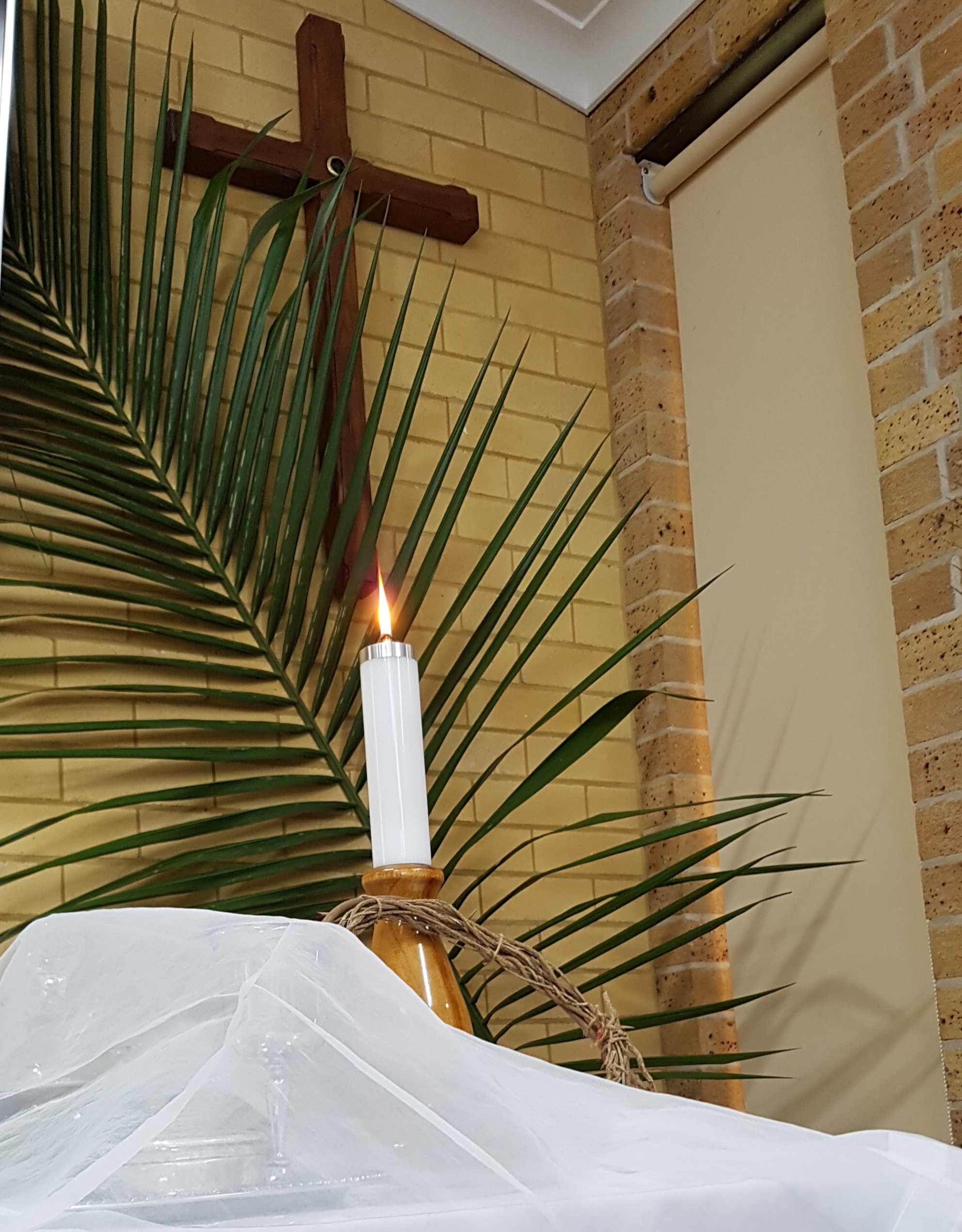
We wonder why Jesus’ ministry had to end this way.Why was it necessary for Jesus to die?They are very reasonable questions, but they are not questions that we would ask if we truly understand what Jesus promised.Take St Peter for example.Jesus prophesied that he must go to Jerusalem and suffer many things at the hands of the elders, the chief priests and the teachers of the law, and that he must be killed and on the third day be raised to life.Peter objected and said, “Never, Lord –this will never happen to you”.But did Peter hear Jesus properly?It is very likely that Peter didn’t hear fully what Jesus said.It is likely that once he heard Jesus say that he must be killed that he stopped paying attention.And that’s what death does.When we hear about death, especially about the death of someone we love it can also make us wonder why.Why does life end?Why is it necessary to die?But Peter needed to listen to Jesus and the totality of what he said:asHe said that after he was killed, on the third day he would be raised to life.But even as Christians we don’t always think of that when we are confronted with death.We don’t automatically think of eternal life when someone we love dies.We are usually so grief stricken thatwe cannot see past the reality of death.Even St Paul acknowledges that when he speaks of Christ’s victory over death.He says: “Where, O death, is your victory? Where, O death, is your sting?” Thanks be to God! He gives us the victory through our Lord Jesus Christ.Whereas death no longer has victory because of Jesus’ death and resurrection it certainly still carries its sting.And that sting is evident every time we sit at the bedside of a loved one –as we watch the coffin lowered into the grave, as we visit the gravesite of our loved ones –the sting of grief in death remains.But Paul also reminds us that we grieve but not as those who have no hope.We have hope because we know that the grave will not hold Jesus for long. We know that on the third daythat he will rise.But those 3 days are so long when it’s someone we love.Even though we know that we will be reunited with all our loved ones as we await the resurrection, it is so hard because the grief is so deep.Asking “why” about death or questioning God’s love because of death won’t remove the sting of death from our experience.Our loved ones will continue to face the reality of death and we shall continue to face the reality of our own death.Death is a reality of life.The only way to truly findcomfort in death is to listen carefully to what Jesus said about his own death.On the third day I will be raised to life.Without death there can be no resurrection.Without Jesus’ resurrection,we can never see death in any other way than an horrific event.Even Jesus’ own death is meaningless without that final part that Peter missed –on the third day I will be raised to life.To outsiders, a battered and broken Jesus who could no longer hold his head up and died in humiliation and defeat could not possibly be anything but a reminder of the pain and finality of death and no hope at all. But to those who believe into him, the true Son of God has completed his great work of defeating death and he cries out “it is finished”.But what is finished?Death’s victory is finished.As St Paul says, “the message of the cross if foolishness to those who are perishing but to us who are being saved it is the power of God”.And the power of God is,that just as Jesus has been raised from the dead,we too shall be raised to eternal life.Jesus’ announcement, “It is finished,” is clear and simple. No long explanations of how –no detailed sermon of what you have to do.Just “it is finished.”Jesus has completed his task that God sent him to do. He came so that you and I can have forgiveness and eternal life. He came to give us the victory of death –the same victory over death that he achieved. He came to ensure that we would enter his kingdom of heaven and live forever.That’s why Jesus had to die because in order todefeat death he had to die and rise from death.And just as Jesus has risen from the dead, we too shall live a new life when we die.Thanks be to God who gives us the victory over death. Amen
Text: John 19:28-30
Jesus knew that by now everything had been completed; and in order to make the scripture come true, he said, “I am thirsty.” A bowl was there, full of cheap wine; so a sponge was soaked in the wine, put on a stalk of hyssop, and lifted up to his lips. Jesus drank the wine and said, “It is finished!”
It was three o’clock. Jesus called for water.  He could hardly speak. A soldier fixed a sponge on a spear and held it up to his lips. It was terribly bitter but it was enough. He strained to raise his head and look up to heaven. “It is finished,” he cried and then he bowed his head and gave up his spirit.
At the time, the moment was filled with too much emotion for those words to sink in and to ponder what they meant. But later as the early Christians read John’s Gospel and heard again those words, it dawned on them just how powerful these dying words of Jesus were. John wrote his Gospel in Greek, and those last words of Jesus are just one word in Greek – tetelestai (pronounced te-tel-es-sty).
The expression “It is finished” or tetelestai was well known to them. It was a part of everyday language.
When a servant had completed a difficult job that his master had given him to do, he would say to the master – tetelestai – “I have overcome all the difficulties; I have done the job to the best of my ability. It is finished”.
When the Jewish people went to the temple with their sacrifice, the High Priest would examine what was brought. Most likely, he didn’t speak Greek but he would use the Hebrew equivalent of tetelestai – meaning, “Your offering is accepted; it is perfect”.
When the merchant at the market place made a sale and the money was handed over, he would say, “tetelestai – the deal is finished, complete. The price has been paid in full. I am satisfied”.
When an artist had finished a painting or a sculpture he would stand back and say, tetelestai – it is finished; there is nothing more that can be done to make this piece of art any better. This painting is complete.
When a boy recited to his father a difficult passage he had learnt from the Scriptures or a girl showed her mother the bread she had baked for the family, they would say tetelestai and the parents responded with, “Well done, my child, I am very proud of you.”
When Jesus spoke those final words he wasn’t just saying, “This is the end of me” as if there was nothing else to do but to give in to his enemies and die. His last words weren’t a final surrender to the power of Satan as if to say, “You have won. I’m done for”. These words don’t tell us that Jesus was dead now and that’s all there is to it. He is finished and so is everything that he stood for and promised during his earthly life.
All those who heard the word tetelestai – the servants, those who offered sacrifices at the temple, the buyers and sellers at the market place, the artists and parents and children understood that Jesus is saying that his job of saving the world has been completed.
He has finished the task and nothing can be added to what has been done.
Jesus has paid the price in full – he has cancelled all debt.
His sacrifice has been a perfect one, acceptable to the heavenly Father who, looking down on his Son hanging lifelessly from the cross, said, “Well done, this is my dear Son with whom I am well pleased”.
Tetelestai – it is finished. Everything is complete!
What is it that is finished when Jesus says, “It is finished”?
Reconciliation is finished. The word ‘reconciliation’ has been used a lot in connection with the relationship between the aboriginal people of our country and the rest of the community. The terrible things that happened in the past have caused a rift between black and white people. Efforts have been made to heal the differences, to close the gap caused by past actions, to restore friendship, to be reconciled.
A terrible gap has come between God and all humanity caused by sin and evil. Our offences, our disobedience, the hurt we have caused God and others have destroyed our relationship with God. Recall a time when you have done something that has hurt someone else and because of that your friendship with that person has been damaged, a gap has come between you, and you felt uneasy when you met that person, in fact you may have avoided that person. All of that doesn’t change until you put aside your differences and friendship is restored.
In the movie Grand Canyon, a tow truck driver is threatened by five troublemakers as he attempts to rescue a terrified motorist. He says, “Man, the world ain’t supposed to work like this. Maybe you don’t know that, but this ain’t the way it’s supposed to be. I’m supposed to be able to do my job without askin’ if I can. And that dude is supposed to able to wait with his car without you rippin’ him off. Everything’s supposed to be different than what it is here.”
And he’s right. Everything’s supposed to be different. God created a perfect beautiful world and he made people to live in harmony and peace with one another. But look what’s happened. We all know what an effect our poorly chosen words and lack of consideration have on our relationship with family members and friends. Greed and selfishness destroy friendship and separate people and nations. That tow truck driver hit the nail on the head when he said – “Man, the world ain’t supposed to work like this”.
Sin has a devastating effect on our relationship with God. Sin separates us from God and if we want to have any hope of going to heaven to be with God, then someone had to deal with sin and restore our relationship with God. So God sent his Son into the world for this very purpose.
Jesus died on the cross to get rid of the power of sin to condemn us. His death bridged the deep gulf between God and us. “Salvation is finished”, Jesus cried. The restoration of the friendship between God and humanity has been finished. The task for which God’s Son came to earth has been completed.
He has won forgiveness for all people.
Nothing else needs to be done.
Salvation is complete. “It is finished”.
That’s why we call today “Good Friday”. It certainly wasn’t a good day for Jesus. He endured pain, soul-wrenching agony, hanging by the nails in his hands for hours, death on a rough wooden cross, for our sakes. We call today “Good Friday” because the cross is proof of the powerful love that God has for each of us. No one, not even God, would do something like that unless he truly loved us. Here we see a love that was prepared to endure the ultimate in order to rescue us.
We have known love to do some very powerful and strange things. A teenager Arthur Hinkley lifted a farm tractor with his bare hands. He wasn’t a weight lifter, but his best friend, eighteen-year-old Lloyd, was pinned under a tractor. Arthur heard Lloyd screaming for help and Arthur somehow lifted the tractor enough for Lloyd to wriggle out. His love for his best friend somehow enabled him to do what would normally be impossible.
There is the story of a priest who offered his life in place of a teenage boy in Nazi Germany. His offer was accepted and the priest died to save the boy’s life.
And then there was the young soldier who had been condemned to death by Oliver Cromwell. He was to be shot at the ringing of the curfew bell. His fiancée climbed the bell tower and tied herself to the clapper of the giant bell so that it would not ring. When the bell did not ring, soldiers went to investigate and found the girl battered and bleeding from being bashed against the sides of the bell. Cromwell was so impressed by her love for the young man that he was pardoned.
Because of love, people do extraordinary things for others. They give us a glimpse, a small glimpse, at the kind of love that God has for us. God the Father sent his dearly loved Son into dangerous territory. He allowed his Son to be treated cruelly. He stood by and watched his innocent Son be nailed to a cross and to hang there in agony. He could have rescued him and cursed those who were treating him so brutally and maliciously. He allowed his Son to carry the sin of all humanity and so become repulsive even to his own Father. I don’t think we can fully appreciate what it meant for the Father to abandon the Son and let him died at the hands of evil people. When Jesus cried out, “My God, My God, why have you forsaken me?” we sense something of the terror of bearing the weight of the sin of all humanity.
God did all this for us. He did all this because of his love for us.
Paul writes, “God has shown us how much he loves us—it was while we were still sinners that Christ died for us! … We were God’s enemies, but he made us his friends through the death of his Son.” (Romans 5:8,10). That’s how much God loves us – Jesus died for us even though we don’t deserve it. His death has made us God’s friends.
Jesus’ announcement, “It is finished” is clear and simple. Jesus has completed his task. The reason why he came as a human has been fulfilled. He came so that you and I can have forgiveness and salvation. He came to give us the victory. He came to ensure that we would enter his kingdom and live forever.
Today we’re going to do an “Altar Call”. You don’t have to get up; you don’t have to raise a hand or say a word. All I want you to do is close your eyes. For a short while, I want you to think about what Jesus has done for you through his death on the cross. Visualise in your mind the suffering Saviour. Think about the love that God has for you, and thank him. Ask God to wrap you tightly in his love – forgiving you, watching over you, guiding you. If you feel that Jesus and his love for you are not real for a large part of your life, ask for his help.
We pray:
Loving God,
what you have done for us in Jesus’ death on the cross is far more than we deserve. His death has made us friends with you again. His death has given us forgiveness and the hope of life forever. Everything is complete. We thank you from the bottom of our hearts. Amen.
© Pastor Vince Gerhardy
 St Peters Lutheran Church Port Macquarie