Text: Colossians 1:15, 20
 Christ is the visible likeness of the invisible God. He is the first-born Son, superior to all created things…. Through the Son, then, God decided to bring the whole universe back to himself. God made peace through his Son’s blood on the cross and so brought back to himself all things, both on earth and in heaven.
Things are not always what they seem. What seems to be the most obvious can be awfully wrong. The gospel reading today is another one of those cases where things are not what they seem to be.
We heard the account of Jesus’ crucifixion as recorded in Luke’s gospel. We are told how Jesus was nailed to a cross between two criminals.
He is weak from all the beatings; his clothes are stripped from him and soldiers gamble for his robe; he suffers the mockery of those standing around the cross. They call out, “If you are a king, then save yourself”. They laughed at his weakness and inability to save himself, they joked about his claim to be a king and now his unkingly naked body was nailed to an instrument of torture – what a joke and what a good laugh they had – a king on a cross – what a ridiculous idea!
But there was one person who saw something in Jesus that no one else saw. In spite of the gashes in his flesh from the whip, the nails, the wounds, the blood, the nakedness and the shame, one of the criminals crucified with Jesus recognised a king. He said to Jesus, “Remember me, Jesus, when you come as King!” Jesus promised him, “Today you will be in Paradise with me”.
A strange king indeed – suffering, weak, humiliated, despised, rejected and dying. But the death of this unlikely king made us friends with God through his death. God was going to stop at nothing to break down all barriers between him and all people. He was even prepared to let the King of king and Lord of lords die in order to make everything right again between him and us.
This is where Paul’s letter to the Colossians picks up the theme of the kingship of Jesus. The apostle goes to great lengths to emphasise that Jesus is God’s Son; he is everything that God is. Through him “everything in heaven and on earth, the seen and the unseen things, including spiritual powers, lords, rulers, and authorities” were created. If he is the creator of all these then, he is also lord and king of everything in heaven and on earth. Paul goes on to say that Jesus is not only king of every part of creation, he is also head of the church; “he is the source of the body’s life”.
Things are not what they seem. This king is all powerful, above all things, the lord of all and master of the whole universe, with multitudes of angels at his beck and call, living in the perfection of heaven. Yet it was not above this king to get down and get dirty. Jesus doesn’t just dress up to be like us, he is one of us. He takes on our human nature and lived among ordinary people especially sinners and outcasts, including lepers and the demon possessed. What happened to him could hardly be regarded as being kingly.
He died on a cross. Just grasp the magnitude of this. The King of kings and Lord of lords, God’s Son, died on a horrible human instrument of torture and death. Not only that, he died for all those who are enemies of God because of the evil things they did and thought (Col 1:21).
In his usual clear and precise way, Paul says, “By means of the physical death of his Son, God has made you his friends, in order to bring you, holy, pure, and faultless, into his presence” (1:22). That’s worth repeating to make it sink in. “By means of the physical death of his Son, God has made you his friends, in order to bring you, holy, pure, and faultless, into his presence”.
Today is the last Sunday of the church year and it is traditional to talk about the end of the world, the end of our life here on this planet as we know it and the certain judgement of God on the Last Day.
This image of the servant-king that Paul and Luke paint for us is so important as we face the prospect of coming face to face with the holy and righteous God. There’s no denying that we are sinners.
There’s no getting around the fact that right up to the last day of our life we will continue to sin in thought, word and deed. The Bible makes it quite clear that our sin condemns us and we would have no chance of surviving the judgement of God on the last day.
But Paul makes it clear that there is nothing to be afraid of. Christ has died for us. Jesus is master and king over sin, death and the power of Satan to condemn us. Jesus’ death has made us friends with God again and made us holy, pure and faultless. Our sin has been wiped away. Forgiven. Forgotten. We will be welcomed into heaven.
Isn’t that what happened to the man dying next to Jesus. In his moment of deepest agony, Jesus tells the criminal who sees in Jesus a king that his sin will no longer be held against him. “Today you will be with me in Paradise”. At a moment when all would seem to be hopeless and without a future, Jesus is truly a king. He pardons and assures the man that he will be with him in Paradise.
Without a doubt, there is a future after death and after the end of this world. Jesus promised the man next to him, “Today you will be with me in Paradise”.
We have a servant-king who died for us and rose from the dead, who has done everything possible to ensure that we need not fear what will happen. At the end of everything, we are safe.
Kings and crosses don’t normally go together but in the case of Jesus they do. Jesus may have been raised to the highest place and given the name that is greater than any other name (Phil 2:9) but this mighty king cannot be separated from the cross on which he died saving you and me. As Paul so nicely summarised, “His Son became a human and died. So God made peace with you, and now he lets you stand in his presence as people who are holy and faultless and innocent” (Col 1:22).
Worship this different kind of king, this Jesus, and trust him.
This is our king – nailed to a cross to rescue us from the powers of darkness and sin.
This is our king – risen and ruling, and “openly proclaim that Jesus Christ is Lord, to the glory of God the Father” (Phil 2:11).
 “Countries will fight each other; kingdoms will attack one another. There will be terrible earthquakes, famines, and plagues everywhere; there will be strange and terrifying things coming from the sky. Before all these things take place, however, you will be arrested and persecuted; you will be handed over to be tried in synagogues and be put in prison; you will be brought before kings and rulers for my sake. …. But not a single hair from your heads will be lost. Stand firm, and you will save yourselves.
 particularly saintly today? Your husband or wife or your Child perhaps? The fact is, we know that we’re all pretty human, and being human means “warts and all”. Most of us have probably said, “I’m no saint”. However, in just a little while we are all going to say the words, ‘I believe in the communion of saints’. And with these words we will confess our belief that there is more to the church than meets the eye.
 true that is on so many occasions. I first heard about the Bali explosions on the radio. The news reporter attempted to give a verbal description of what had happened and the devastation that had occurred in that otherwise peaceful and fun-loving place. However, it wasn’t until I turned on the TV and saw the pictures of the destruction, the stretchers and ambulances, the overcrowded hospital that the full extent of the situation really hit home. Those pictures described what thousands of words weren’t able to do.
 the Mosaic law and its traditions relating to life and worship. They were jealous for the sacred history of God’s people; God’s unique provisions for the Jewish people. Israel as God’s people, made to be who they are as distinct from the rest of humanity by God’s gracious call of their ancestors, Abraham, Isaac and Jacob who is renamed Israel. This call took the form of a covenant- including the gift of the Law, the ten commandments. The unique identifier of the Jewish people and religion through their entire history to the present day. The Pharisees were the guardians of this tradition and the understanding of its significance for the survival of Israel as the people of God. Their description as Pharisees comes from the Hebrew word פרושים prushim from פרוש parush, meaning “separated,” that is, one who is separated for a life of dedication to law and purity.
 can’t help but communicate with Him.
  and sometimes doesn’t. You might say the terrorist who didn’t pay enough postage on a letter bomb experienced some bad luck. It came back with “Return to Sender” stamped on it. Forgetting it was the bomb; he opened it.
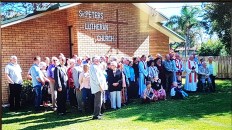
 St Peters Lutheran Church Port Macquarie